Saturday, September 24, 2011
The Buffet Tax Deception
Monday, September 05, 2011
Homeland Security, The Knowledge Problem & Constitution Week
"Central economic planning can't work, explained Hayek, because no small number of people at the top, however brilliant or informed, can aggregate all the trillions of pieces of data needed to plan an economy well. The main information that matters in real time is what Hayek called "knowledge of particular circumstances of time and place" and this information is necessarily decentralized: it exists only fleetingly in the minds of millions of people.....Hayek's argument applies whether the good being produced is food, steel, or internal security. In fact, in her testimony before the 9/11Commission, Dr. Rice explained the problems with centralization eloquently;
You have thousands of pieces of information . . . and you have to depend to a certain degree on the intelligence agencies to tell you what is actually relevant,
what is actually based on sound sources, what is speculative.
The lesson of September 11 is not that government should plan better and not that a Republican president plans better or worse than a Democrat president. The lesson of 9/11 is that central planning doesn't work and that government should not get in the way of our planning. " LINK
In addition to the 'knowledge problem' discussed above, Sobel and Leeson have identified several other issues with the top down approaches in homeland security regarding incentives, the tragedy of the anticommons, and type II error policy bias. Absent market prices, how do we deal with these issues? Attempts to address these problems, to some extent, can be found in scholarship related to homeland security and federalism:
"an agency that forms partnerships with state and local governments instead of coercive top-down regulation-heavy regimes is an appropriate response on the part of the national government to deal with the particular needs of all the other governments in this country. Further, this agency should work at giving state and local governments as much flexibility as possible in dealing with own-source challenges. By facilitating cooperative networks of communities/jurisdictions a far more realistic and pragmatic approach to all hazards preparedness is a logical outcome. The national government should provide the organization around which such networking might take place." –Homeland Security Affairs VI, no. 2 (May 2010) – Sam Clovis
Efficient Markets and Prices
"I prefer true but imperfect knowledge, even if it leaves much indetermined and unpredictable, to a pretence of exact knowledge" - F.A. Hayek
"The financial crisis invalidated a naïve notion of "efficient markets," but the most sophisticated version is still viable. Whereas the invalidated version holds that markets never err and always adjust instantaneously, the sophisticated version, associated with the ideas of Adam Smith and F. A. Hayek, holds that markets mobilize individuals to realize gains from trade and to innovate and thereby produce generalized prosperity.""In the 1940s, Hayek warned his fellow economists of the misleading standards of perfect competition and static efficiency in assessing the market economy. As he wrote in Individualism and Economic Order, "[T]hese adjustments are probably never 'perfect' in the sense which the economist conceives them in his equilibrium analysis. But I fear that our theoretical habits of approaching the problem with the assumption of more or less perfect knowledge on the part of almost everyone has made us somewhat blind to the true function of the price mechanism and led us to apply rather misleading standards in judging its efficiency" (1948, 87)"
"The great free market economic thinkers from Adam Smith to F. A. Hayek never argued that individuals were hyper-rational actors possessed with full and complete information, operating in perfectly competitive markets.... Efficient markets are an outcome of a process of discovery, learning, and adjustment, not an assumption going into the analysis."
Friday, September 02, 2011
Taxes, Elasticity, Revenue, and Economic Activity
tax increases to be highly contractionary with a negative effect on investment
Alesina, Alberto and Silvia Ardagna (2010) "Large Changes in Fiscal Policy: Taxes versus Spending" In Jeffrey Brown, 2010. "Tax Policy and the Economy, Volume 24," NBER Books, National Bureau of Economic Research.
Fiscal stimulis based on tax cuts increases the probability of future economic growth greater than spending
Carroll, Robert, Douglas Holtz-Eakin, Mark Rider, and Harvey Rosen (2000) "Income Taxes and Entrepreneurs Use of Labor," Journal of Labor Economics, 18 (2), April pp. 324-55
Increases in marginal tax rates reduce the probability of future increased hiring and are associaed with reduced growth in wages.
Gruber, Jon and Saez, Emmanuel, 2002. "The elasticity of taxable income: evidence and implications," Journal of Public Economics, vol. 84(1), pages 1-32.
Finds a very elastic response for incomes over $100k, (.57) with an elasticity of about .17 for incomes < $100k.
Gentry, William and Glenn Hubbard (2000) "Tax Policy and Entrepreneurial Entry" American Economic Review, vol. 90, pp. 283-287.
Finds a significant increase in entrepreneurial activity when tax rates are less progressive.
Djankov, Simeon, Tim Ganser, Caralee McLiesh, Rita Ramalho, and Andrei Shleifer, (2010). "The Effect of Corporate Taxes on Investment and Entrepreneurship," American Economic Journal: Macroeconomics, vol. 2(3), pages 31-64, July.American Economic Association.
"our estimates of the effective corporate tax rate have a large adverse impact on aggregate investment, FDI, and entrepreneurial activity"
The Effect of Marginal Tax Rates on Taxable Income: A Panel Study of the 1986 Tax Reform Act Martin Feldstein Journal of Political Economy
Vol. 103, No. 3 (Jun., 1995), pp. 551-572
Estimates the elasticity of taxable income to range from about 1.0 -3.
Lindsey, Lawrence B. 1987. "Individual Taxpayer Response to Taxcuts, 1982-1984." J. of Public Economics 33 (July) 173-206
Found elasticity of taxable income by income category to be .728 for income > $50k, 1.023 for >$100k, 1.413 for >$250k, and 2.0 for > $1 million. Also derived the tax revenue responses to reductions in marginal taxes for those earning more than $200k / yr. Revenues increased by 19% in 1982, 35% in 1983, 56% in 1984.
WHY DO EUROPEANS WORK (MUCH) LESS? IT IS TAXES AND GOVERNMENT SPENDING
Economic Inquiry, 2008, vol. 46, issue 2, pages 197-207
And
Why Do Americans Work So Much More Than Europeans?
Federal Reserve Bank of Minneapolis Quarterly Review
Vol. 28, No. 1, July 2004, pp. 2–13
Finds that taxes, and particularly higher marginal tax rates have a negative effect on labor hours.
Saturday, August 20, 2011
Rent Seeking and Biotechnology
Monday, August 15, 2011
AgBiotech combating climate change « The Berkeley Blog
Some teasers:
"GMOs in the US and in other countries, reduce significantly the use of rather toxic pesticide chemicals and there is evidence that they actually save significant amount of lives in India and China. "
"It is easy to show that if restrictions on the adoption of GMOs would have been removed and adoption rates of GM varieties in Europe would have been similar to the observed patterns of adoption, then much of the recent increase in commodity food prices would have been diminished. Introduction of GM varieties to wheat and rice would have further reduced commodity prices whereby helping the poor and would have released resources for other uses."
"The land use saving effect of GM varieties is estimated to have the equivalent effect of taking between 800,000-9 million passenger cars off of the road....The use of herbicide-tolerant varieties enable large scale adoption of low-tillage practices that sequester carbon and greenhouse gas sequestering effect is estimated to be equal to that of taking 6.4 million cars off the road."
"The heavy regulation of GMOs are unsound not only because of the loss of benefits from existing varieties, but because of the loss of potential benefits from newer applications of GMOs"
Sunday, August 14, 2011
Greg Mankiw's Blog: What nation has the most progressive tax system?
The top 10% of earners earn about 33.5% of all income on the U.S. but pay 45.1% of taxes. They in essence pay 35% more in taxes than what they earn as a share of income.
There is also an interesting discussion on how these numbers are used and interpreted.
http://gregmankiw.blogspot.com/2011/03/what-nation-has-most-progressive-tax.html
Saturday, August 13, 2011
The Economics of the S&P Downgrade
New Research On Fair Trade Coffee
By Colleen Haight. Stanford Social Innovation Review Summer 2011 link
My field and analytical research has found that there are distinct limitations to the Fair Trade model.7 Perhaps the most serious challenge is the extraordinarily high price of coffee. “The market today is five times higher than when FLO entered the United States. The market’s at $2.50 (per pound for commodity coffee) today vs. the 40 cents or 50 cents (per pound) it was at in 2001,” says Dennis Macray, former director of global sustainability at Starbucks Coffee Co. This price shift dampens farmers’ desire to sell their high-quality coffee at the Fair Trade price. Many co-ops, according to Macray, are choosing to default on the Fair Trade contracts, so that they can do better for their members by selling on the open market.
(HT to Knowledge Problem )
Monday, August 08, 2011
ScienceDirect - Ecological Economics : Impact of Bt cotton on pesticide poisoning in
A case of the internalization of negative externalities via technological change and market forces w/o taxes or new regulations.
Abstract
While substantial research on the productivity and profit effects of Bt cotton has been carried out recently, the economic evaluation of positive and negative externalities has received much less attention. Here, we focus on farmer health impacts resulting from Bt-related changes in chemical pesticide use. Previous studies have documented that Bt cotton has reduced the problem of pesticide poisoning in developing countries, but they have failed to account for unobserved heterogeneity between technology adopters and non-adopters. We use unique panel survey data from India to estimate unbiased effects and their developments over time. Bt cotton has reduced pesticide applications by 50%, with the largest reductions of 70% occurring in the most toxic types of chemicals. Results of fixed-effects Poisson models confirm that Bt has notably reduced the incidence of acute pesticide poisoning among cotton growers. These effects have become more pronounced with increasing technology adoption rates. Bt cotton now helps to avoid several million cases of pesticide poisoning in India every year, which also entails sizeable health cost savings.
Saturday, July 23, 2011
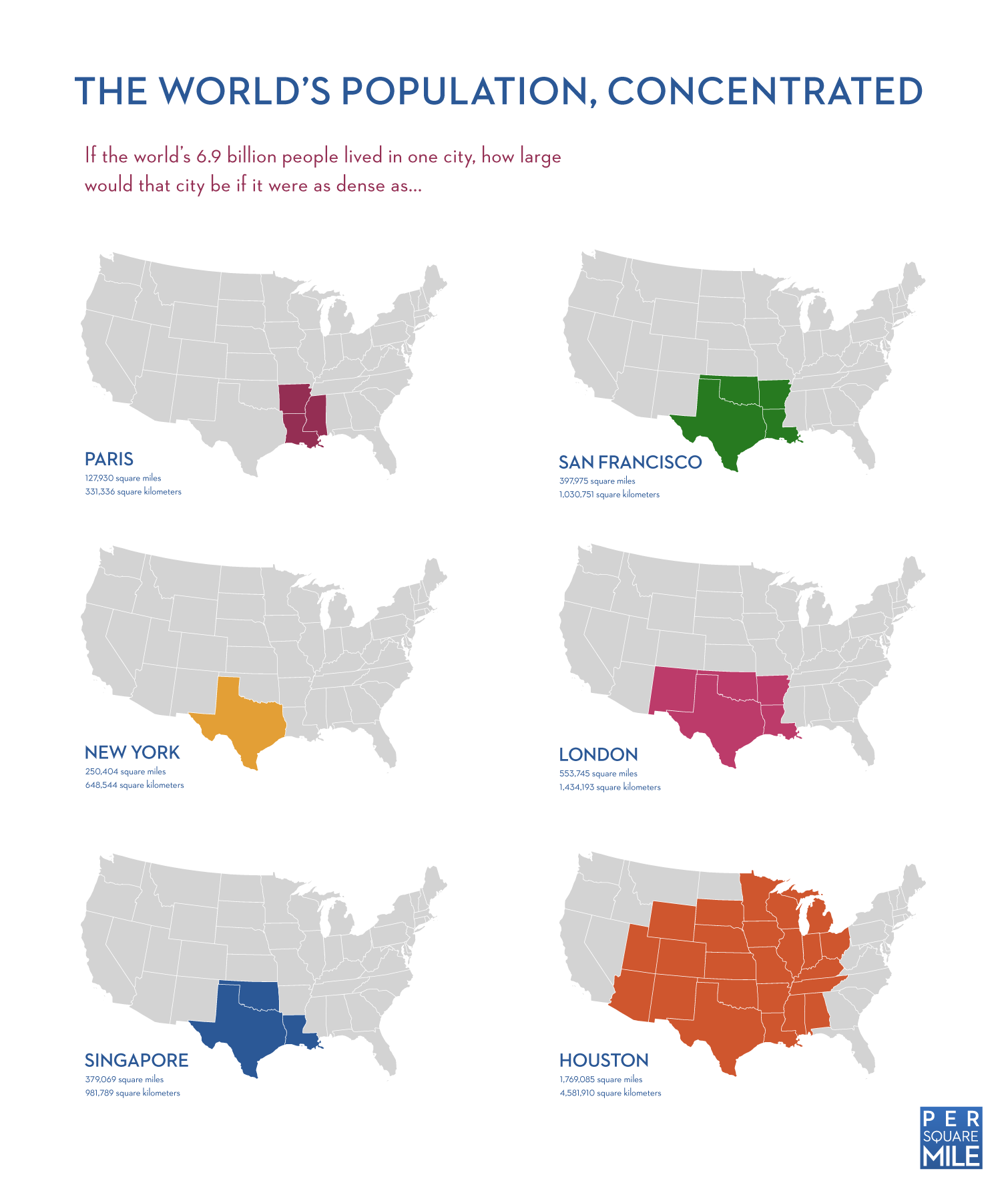
Overpopulation? Not
Overpopulation? Not
http://persquaremile.files.wordpress.com/2011/01/the-worlds-population-concentrated.png
Thursday, July 21, 2011
Jobs for Data Scientists Explode Across The Market - NYTimes.com
Friday, July 15, 2011
PSST- Regime Uncertainty?
Without venturing here an opinion on the underlying source of each and every recession throughout American history, I will express an opinion about the current recession: it is clearly the result of distorting government policies, regulatory and monetary, leading up to 2008 as well as of the symptom-treating policies since then that only worsen matters. (And not to mention yet other actual and threatened policies"
Wednesday, July 13, 2011
Walmart Express and Food Deserts
I think some people would like to blame 'food deserts' on profit oriented retailors and 'industrial agriculture'. But here we have an example where a big box retailer is being presented as a possible solution to the 'food desert' dilemma. It make sense that given the extensive hurdles to bringing healthy food to some markets (forgetting for a moment those barriers associated with production agriculture) such as minimum wages, risk,liability, the war on drugs, taxes, and the regulatory environment, that a company like Wal-Mart could leverage their supply chain and possibly make a profit where no one else can.
Sunday, July 10, 2011
Drovers CattleNetwork - Agsight: No speculators? No thanks! - Cattle News - Editorial, Grain & Cattle Markets, Current Stories
http://www.cattlenetwork.com/cattle-news/Agsight-No-speculators-No-thanks.html
Sent from my iPod touch
Saturday, July 09, 2011
Top #Obama Aid Calls For Deregulation of #GMO #Food
Rethinking Regulations for Biotech Crops - http://www.truthabouttrade.org/news/editorials/trade-policy-analysis/18078-rethinking-regulations-for-biotech-crops
Thursday, July 07, 2011
Review & Outlook: The Jobless Summer - WSJ.com
Saturday, July 02, 2011
A Picture of The Minimum Wage
http://mjperry.blogspot.com/2011/06/but-at-least-politicians-care-in-theory.html
- The minimum wage reduces employment.
Currie and Fallick (1993), Gallasch (1975), Gardner (1981), Peterson (1957), Peterson and Stewart (1969). - The minimum wage reduces employment more among teenagers than adults.
Adie (1973); Brown, Gilroy and Kohen (1981a, 1981b); Fleisher (1981); Hammermesh (1982); Meyer and Wise (1981, 1983a); Minimum Wage Study Commission (1981); Neumark and Wascher (1992); Ragan (1977); Vandenbrink (1987); Welch (1974, 1978); Welch and Cunningham (1978). - The minimum wage reduces employment most among black teenage males.
Al-Salam, Quester, and Welch (1981), Iden (1980), Mincer (1976), Moore (1971), Ragan (1977), Williams (1977a, 1977b). - The minimum wage helped South African whites at the expense of blacks.
Bauer (1959). - The minimum wage hurts blacks generally.
Behrman, Sickles and Taubman (1983); Linneman (1982). - The minimum wage hurts the unskilled.
Krumm (1981). - The minimum wage hurts low wage workers.
Brozen (1962), Cox and Oaxaca (1986), Gordon (1981). - The minimum wage hurts low wage workers particularly during cyclical downturns.
Kosters and Welch (1972), Welch (1974). - The minimum wage increases job turnover.
Hall (1982). - The minimum wage reduces average earnings of young workers.
Meyer and Wise (1983b). - The minimum wage drives workers into uncovered jobs, thus lowering wages in those sectors.
Brozen (1962), Tauchen (1981), Welch (1974). - The minimum wage reduces employment in low-wage industries, such as retailing.
Cotterman (1981), Douty (1960), Fleisher (1981), Hammermesh (1981), Peterson (1981). - The minimum wage hurts small businesses generally.
Kaun (1965). - The minimum wage causes employers to cut back on training.
Hashimoto (1981, 1982), Leighton and Mincer (1981), Ragan (1981). - The minimum wage has long-term effects on skills and lifetime earnings.
Brozen (1969), Feldstein (1973). - The minimum wage leads employers to cut back on fringe benefits.
McKenzie (1980), Wessels (1980). - The minimum wage encourages employers to install labor-saving devices.
Trapani and Moroney (1981). - The minimum wage hurts low-wage regions, such as the South and rural areas.
Colberg (1960, 1981), Krumm (1981). - The minimum wage increases the number of people on welfare.
Brandon (1995), Leffler (1978). - The minimum wage hurts the poor generally.
Stigler (1946). - The minimum wage does little to reduce poverty.
Bonilla (1992), Brown (1988), Johnson and Browning (1983), Kohen and Gilroy (1981), Parsons (1980), Smith and Vavrichek (1987). - The minimum wage helps upper income families.
Bell (1981), Datcher and Loury (1981), Johnson and Browning (1981), Kohen and Gilroy (1981). - The minimum wage helps unions.
Linneman (1982), Cox and Oaxaca (1982). - The minimum wage lowers the capital stock.
McCulloch (1981). - The minimum wage increases inflationary pressure.
Adams (1987), Brozen (1966), Gramlich (1976), Grossman (1983). - The minimum wage increases teenage crime rates.
Hashimoto (1987), Phillips (1981). - The minimum wage encourages employers to hire illegal aliens.
Beranek (1982). - Few workers are permanently stuck at the minimum wage.
Brozen (1969), Smith and Vavrichek (1992). - The minimum wage has had a massive impact on unemployment in Puerto Rico.
Freeman and Freeman (1991), Rottenberg (1981b). - The minimum wage has reduced employment in foreign countries.
Canada: Forrest (1982); Chile: Corbo (1981); Costa Rica: Gregory (1981); France: Rosa (1981). - Characteristics of minimum wage workers
Employment Policies Institute (1994), Haugen and Mellor (1990), Kniesner (1981), Mellor (1987), Mellor and Haugen (1986), Smith and Vavrichek (1987), Van Giezen (1994).
References
Finds that an increase in the minimum wage from $3.35 to $4.65 over three years would increase the unemployment rate by less than 0.1% and the inflation rate by 0.2%.Adie, Douglas K. 1973. Teen-Age Unemployment and Real Federal Minimum Wages. Journal of Political Economy, vol. 81 (March/April): 435-441.
Friday, July 01, 2011
1 Million Dollars: Pennywise Pound Poor Deficit Reduction Ideas
A parity of our political leaders discussion of budget cuts and tackling the deficit? This especially reminds me of the political posturing we get from the right and the left (like in a recent NYT article) discussing cuts to farm subsidies. Cutting the entire farm program budget amounts to less than 1/2 of 1 % of total government spending. Given the problems with medicare and social security, it seems like it costs us more to simply discuss farm subsidies than what we will ever end up saving through cuts. Some groups like the EWG have spent a lot of resources tracking farm subsidy data. Why? I guarantee it is not a fiscally minded agenda. They are more concerned with politically correct agriculture than sustainable farms or government, and I guarantee if subsidies were redirected to organic and local backyard production, the EWG data base would probably go away while the deficit grows and the check is in the mail for wealthy special interests.