HT to Cafe Hayek, I've been looking for thus data a while.
Saturday, July 23, 2011


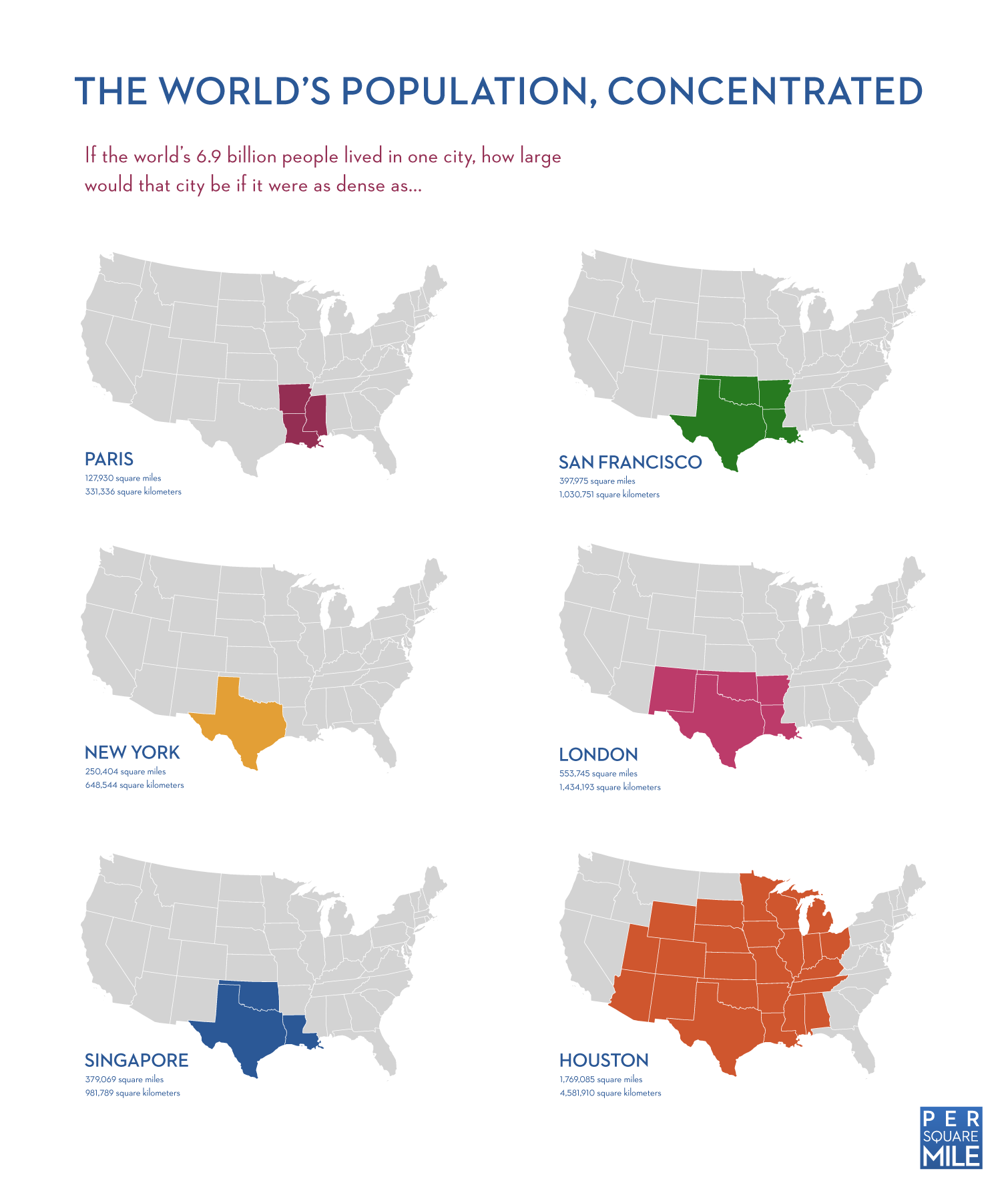
Overpopulation? Not
HT to Cafe Hayek, I've been looking for this data some time now, and I finally found it. The ramifications in terms of recycling, landfill space etc in relation to this are interesting to think about.
http://persquaremile.files.wordpress.com/2011/01/the-worlds-population-concentrated.png
Thursday, July 21, 2011
Jobs for Data Scientists Explode Across The Market - NYTimes.com
Data scientist positions are outpacing demand growth for statisticians- 'data scientists' are typically more well rounded in terms of theoretical and applied statistical knowledge, programming & data hacking skills, and industry subject matter as opposed to traditional statisticians.
Friday, July 15, 2011
PSST- Regime Uncertainty?
From Cafe Hayek- a framework for discussing the debt ceiling, the deficit, the financial crisis, recession, & what to do about it:
"But if the decline in GDP growth and in the rate of employment are caused, not by a taste-driven increase in the demand for money but, instead, by a large enough disruption in what Arnold Kling calls "patterns of sustainable specialization and trade," then kicking up aggregate demand won't solve the problem. Neither kicking it up, or trying to, through monetary policy or through fiscal policy will work. The problem is not originally one of widespread inadequate demand. In thiscase, inadequate aggregate demand is a symptom; treating the symptom will not cure the disease and, indeed, will only worsen it.
Without venturing here an opinion on the underlying source of each and every recession throughout American history, I will express an opinion about the current recession: it is clearly the result of distorting government policies, regulatory and monetary, leading up to 2008 as well as of the symptom-treating policies since then that only worsen matters. (And not to mention yet other actual and threatened policies"
Wednesday, July 13, 2011
Walmart Express and Food Deserts
From the Knowledge Problem blog:
I think some people would like to blame 'food deserts' on profit oriented retailors and 'industrial agriculture'. But here we have an example where a big box retailer is being presented as a possible solution to the 'food desert' dilemma. It make sense that given the extensive hurdles to bringing healthy food to some markets (forgetting for a moment those barriers associated with production agriculture) such as minimum wages, risk,liability, the war on drugs, taxes, and the regulatory environment, that a company like Wal-Mart could leverage their supply chain and possibly make a profit where no one else can.
Of course, Wal-Mart is no clear capitalist hero. Many of these progressive policies that have contributed to 'food deserts' likely found their way on corporate lobbyists' to do list. The essence of rent seeking is to expend resources to carve out a secure niche in the tax and regulatory environment.
Sunday, July 10, 2011
Drovers CattleNetwork - Agsight: No speculators? No thanks! - Cattle News - Editorial, Grain & Cattle Markets, Current Stories
A great article on commodity market speculation
http://www.cattlenetwork.com/cattle-news/Agsight-No-speculators-No-thanks.html
Sent from my iPod touch
Saturday, July 09, 2011
Top #Obama Aid Calls For Deregulation of #GMO #Food
"Dr. Beachy asked the subcommittee to consider the unintended consequences of overly stringent regulations of biotech crops. These include creating the perception that the technology is unsafe and causing many developing countries to be reluctant to adopt the technology. He noted, "It (the regulatory process) has adapted poorly in response to the proven safety record and absence of adverse affect on the environment or on animal and human health of GE crops. It has not adapted to changes that have further enhanced the safety of the technologies; and it has not adapted to the needs of the market. The system needs attention, modification, and improvement if the U.S. and global agriculture communities and its consumers are to benefit from the investment in past and current science and technology that can impact agriculture and agriforestry."
Rethinking Regulations for Biotech Crops - http://www.truthabouttrade.org/news/editorials/trade-policy-analysis/18078-rethinking-regulations-for-biotech-crops
Rethinking Regulations for Biotech Crops - http://www.truthabouttrade.org/news/editorials/trade-policy-analysis/18078-rethinking-regulations-for-biotech-crops
Thursday, July 07, 2011
Review & Outlook: The Jobless Summer - WSJ.com
A very good piece on the minimum wage and the negative impacts on future income earning opportunities.
Saturday, July 02, 2011
A Picture of The Minimum Wage
Image Source: Mark Perry
http://mjperry.blogspot.com/2011/06/but-at-least-politicians-care-in-theory.html
http://mjperry.blogspot.com/2011/06/but-at-least-politicians-care-in-theory.html
Below is a summary of most of the research in this area. (this is a direct copy/paste from the U.S. Congress Joint Economic Committee Report '50 Years of Research on the Minimum Wage, 1995). Note, very few studies [Card (1992b), Card and Krueger (1994), and Katz and Krueger (1992)] empirically challenge the consensus that minimum wages make it harder for individuals to find jobs or that they suffer loss of employment as a result.
- The minimum wage reduces employment.
Currie and Fallick (1993), Gallasch (1975), Gardner (1981), Peterson (1957), Peterson and Stewart (1969). - The minimum wage reduces employment more among teenagers than adults.
Adie (1973); Brown, Gilroy and Kohen (1981a, 1981b); Fleisher (1981); Hammermesh (1982); Meyer and Wise (1981, 1983a); Minimum Wage Study Commission (1981); Neumark and Wascher (1992); Ragan (1977); Vandenbrink (1987); Welch (1974, 1978); Welch and Cunningham (1978). - The minimum wage reduces employment most among black teenage males.
Al-Salam, Quester, and Welch (1981), Iden (1980), Mincer (1976), Moore (1971), Ragan (1977), Williams (1977a, 1977b). - The minimum wage helped South African whites at the expense of blacks.
Bauer (1959). - The minimum wage hurts blacks generally.
Behrman, Sickles and Taubman (1983); Linneman (1982). - The minimum wage hurts the unskilled.
Krumm (1981). - The minimum wage hurts low wage workers.
Brozen (1962), Cox and Oaxaca (1986), Gordon (1981). - The minimum wage hurts low wage workers particularly during cyclical downturns.
Kosters and Welch (1972), Welch (1974). - The minimum wage increases job turnover.
Hall (1982). - The minimum wage reduces average earnings of young workers.
Meyer and Wise (1983b). - The minimum wage drives workers into uncovered jobs, thus lowering wages in those sectors.
Brozen (1962), Tauchen (1981), Welch (1974). - The minimum wage reduces employment in low-wage industries, such as retailing.
Cotterman (1981), Douty (1960), Fleisher (1981), Hammermesh (1981), Peterson (1981). - The minimum wage hurts small businesses generally.
Kaun (1965). - The minimum wage causes employers to cut back on training.
Hashimoto (1981, 1982), Leighton and Mincer (1981), Ragan (1981). - The minimum wage has long-term effects on skills and lifetime earnings.
Brozen (1969), Feldstein (1973). - The minimum wage leads employers to cut back on fringe benefits.
McKenzie (1980), Wessels (1980). - The minimum wage encourages employers to install labor-saving devices.
Trapani and Moroney (1981). - The minimum wage hurts low-wage regions, such as the South and rural areas.
Colberg (1960, 1981), Krumm (1981). - The minimum wage increases the number of people on welfare.
Brandon (1995), Leffler (1978). - The minimum wage hurts the poor generally.
Stigler (1946). - The minimum wage does little to reduce poverty.
Bonilla (1992), Brown (1988), Johnson and Browning (1983), Kohen and Gilroy (1981), Parsons (1980), Smith and Vavrichek (1987). - The minimum wage helps upper income families.
Bell (1981), Datcher and Loury (1981), Johnson and Browning (1981), Kohen and Gilroy (1981). - The minimum wage helps unions.
Linneman (1982), Cox and Oaxaca (1982). - The minimum wage lowers the capital stock.
McCulloch (1981). - The minimum wage increases inflationary pressure.
Adams (1987), Brozen (1966), Gramlich (1976), Grossman (1983). - The minimum wage increases teenage crime rates.
Hashimoto (1987), Phillips (1981). - The minimum wage encourages employers to hire illegal aliens.
Beranek (1982). - Few workers are permanently stuck at the minimum wage.
Brozen (1969), Smith and Vavrichek (1992). - The minimum wage has had a massive impact on unemployment in Puerto Rico.
Freeman and Freeman (1991), Rottenberg (1981b). - The minimum wage has reduced employment in foreign countries.
Canada: Forrest (1982); Chile: Corbo (1981); Costa Rica: Gregory (1981); France: Rosa (1981). - Characteristics of minimum wage workers
Employment Policies Institute (1994), Haugen and Mellor (1990), Kniesner (1981), Mellor (1987), Mellor and Haugen (1986), Smith and Vavrichek (1987), Van Giezen (1994).
References
Finds that an increase in the minimum wage from $3.35 to $4.65 over three years would increase the unemployment rate by less than 0.1% and the inflation rate by 0.2%.Adie, Douglas K. 1973. Teen-Age Unemployment and Real Federal Minimum Wages. Journal of Political Economy, vol. 81 (March/April): 435-441.
Friday, July 01, 2011
1 Million Dollars: Pennywise Pound Poor Deficit Reduction Ideas
Remember this scene from the Austin Powers movie?
A parity of our political leaders discussion of budget cuts and tackling the deficit? This especially reminds me of the political posturing we get from the right and the left (like in a recent NYT article) discussing cuts to farm subsidies. Cutting the entire farm program budget amounts to less than 1/2 of 1 % of total government spending. Given the problems with medicare and social security, it seems like it costs us more to simply discuss farm subsidies than what we will ever end up saving through cuts. Some groups like the EWG have spent a lot of resources tracking farm subsidy data. Why? I guarantee it is not a fiscally minded agenda. They are more concerned with politically correct agriculture than sustainable farms or government, and I guarantee if subsidies were redirected to organic and local backyard production, the EWG data base would probably go away while the deficit grows and the check is in the mail for wealthy special interests.
A parity of our political leaders discussion of budget cuts and tackling the deficit? This especially reminds me of the political posturing we get from the right and the left (like in a recent NYT article) discussing cuts to farm subsidies. Cutting the entire farm program budget amounts to less than 1/2 of 1 % of total government spending. Given the problems with medicare and social security, it seems like it costs us more to simply discuss farm subsidies than what we will ever end up saving through cuts. Some groups like the EWG have spent a lot of resources tracking farm subsidy data. Why? I guarantee it is not a fiscally minded agenda. They are more concerned with politically correct agriculture than sustainable farms or government, and I guarantee if subsidies were redirected to organic and local backyard production, the EWG data base would probably go away while the deficit grows and the check is in the mail for wealthy special interests.
Tuesday, June 28, 2011
Do we get more energy out of ethanol than it takes to make it?
"Overall then, ethanol has made the transition from an energy sink, to a moderate net energy gain in the 1990s, to a substantial net energy gain in the present."
2008 Energy Balance for the Corn-Ethanol Industry. USDA
Monday, June 20, 2011
Friday, June 17, 2011
Regulating Commerce
Given the recent talk from the department of transportation regarding the possibility of requiring farmers and ranchers to have commercial drivers licenses, I thought I'd revisit some the flawed ideas related to the commerce clause. As it is, one of the regulator's primary concerns is if agricultural activity in this sense constitutes 'interstate commerce.'
In the case Wickard v. Filburn (1942) the Agricultural Adjustment Act (AAA) was found to be constitutional. This was on the basis that congress had a right to ‘regulate commerce.’
The power to ‘regulate commerce’ can be found article 1 Section 8 of the constitution. It is listed as one of the enumerated powers of the constitution:
‘To regulate Commerce with the foreign Nations, and among the several States, and with the Indian Tribes;’
In this case a farmer’s crop was being taxed because he produced more than was allowed under the AAA. His defense was that the federal government had no power or business telling him what he could grow on his private property in his state.
The court concluded that even though his crop was grown on his land in his state, it was possible that after he sold it, it could be marketed with grain harvested by other producers across the country. As a result this was considered ‘interstate commerce’ and could be regulated or taxed. The court did not give any more specific definition of ‘interstate commerce’ and set a precedent that if an activity could be considered ‘interstate commerce’ in theory, then it was subject to federal jurisdiction.
Was the court’s decision consistent with what was written in the constitution and our founder’s intentions? How broad did they interpret the power to regulate commerce?
What was meant by regulating congress among the several states?
In Federalist # 45 we read the following:
‘The powers delegated by the proposed constitution to the federal government are few and defined. Those which are to remain in the state governments are numerous and indefinite.’
‘The powers reserved to the several states will extend to all the objects which, in the ordinary course of affairs, concern the lives, liberties, and properties of the people and the internal order, improvement, and prosperity of the state.’
It appears here that our founders never intended for the federal government to be very involved with business and agriculture in the states. The Wickard interpretation is very broad. It does not seem consistent with the idea that the powers of the federal government are few or defined. It is obvious that this decision is contrary to our founder’s idea of limited government.
If we read Federalist # 41, six powers of the federal government are identified and explained. Two of these described the federal government’s relationship with regard to interstate commerce.
‘Maintenance and Harmony and proper intercourse among the states.’
‘Restraint of the states from certain injurious acts.’
To put this in context, after the American Revolution, some of the states were imposing tariffs on each other. The purpose of the interstate commerce clause was to prevent these kinds of ‘injurious acts’ so that trade and ‘proper intercourse’ could take place between the states. The founders never intended that the federal government should have the power to control every aspect of trade that occurred in or even between the states.
Given this history and the state of fear that our founders had of a powerful government, they would have never ratified the constitution if they thought ‘to regulate commerce’ meant congress would have the power to intervene in private business based on nothing more than a theoretical connection to interstate commerce. Wickard v Filburn lead to a huge expansion of power unanticipated by our founders, and a transfer of power away from the people and states without their consent.The purpose of the constitution was to ensure that the government did very little without the consent of the governed. Court cases like these leave us defensless.
As quoted from Ayn Rand’s book Atlas Shrugged ‘ …the government’s plans cannot be held up by the matter of your consent.’
Re-printed from my AgWeb post: http://www.agweb.com/blog/Economic_Sense_190/Regulating_Commerce_Agricultural_History_18256/
In the case Wickard v. Filburn (1942) the Agricultural Adjustment Act (AAA) was found to be constitutional. This was on the basis that congress had a right to ‘regulate commerce.’
The power to ‘regulate commerce’ can be found article 1 Section 8 of the constitution. It is listed as one of the enumerated powers of the constitution:
‘To regulate Commerce with the foreign Nations, and among the several States, and with the Indian Tribes;’
In this case a farmer’s crop was being taxed because he produced more than was allowed under the AAA. His defense was that the federal government had no power or business telling him what he could grow on his private property in his state.
The court concluded that even though his crop was grown on his land in his state, it was possible that after he sold it, it could be marketed with grain harvested by other producers across the country. As a result this was considered ‘interstate commerce’ and could be regulated or taxed. The court did not give any more specific definition of ‘interstate commerce’ and set a precedent that if an activity could be considered ‘interstate commerce’ in theory, then it was subject to federal jurisdiction.
Was the court’s decision consistent with what was written in the constitution and our founder’s intentions? How broad did they interpret the power to regulate commerce?
What was meant by regulating congress among the several states?
In Federalist # 45 we read the following:
‘The powers delegated by the proposed constitution to the federal government are few and defined. Those which are to remain in the state governments are numerous and indefinite.’
‘The powers reserved to the several states will extend to all the objects which, in the ordinary course of affairs, concern the lives, liberties, and properties of the people and the internal order, improvement, and prosperity of the state.’
It appears here that our founders never intended for the federal government to be very involved with business and agriculture in the states. The Wickard interpretation is very broad. It does not seem consistent with the idea that the powers of the federal government are few or defined. It is obvious that this decision is contrary to our founder’s idea of limited government.
If we read Federalist # 41, six powers of the federal government are identified and explained. Two of these described the federal government’s relationship with regard to interstate commerce.
‘Maintenance and Harmony and proper intercourse among the states.’
‘Restraint of the states from certain injurious acts.’
To put this in context, after the American Revolution, some of the states were imposing tariffs on each other. The purpose of the interstate commerce clause was to prevent these kinds of ‘injurious acts’ so that trade and ‘proper intercourse’ could take place between the states. The founders never intended that the federal government should have the power to control every aspect of trade that occurred in or even between the states.
Given this history and the state of fear that our founders had of a powerful government, they would have never ratified the constitution if they thought ‘to regulate commerce’ meant congress would have the power to intervene in private business based on nothing more than a theoretical connection to interstate commerce. Wickard v Filburn lead to a huge expansion of power unanticipated by our founders, and a transfer of power away from the people and states without their consent.The purpose of the constitution was to ensure that the government did very little without the consent of the governed. Court cases like these leave us defensless.
As quoted from Ayn Rand’s book Atlas Shrugged ‘ …the government’s plans cannot be held up by the matter of your consent.’
Re-printed from my AgWeb post: http://www.agweb.com/blog/Economic_Sense_190/Regulating_Commerce_Agricultural_History_18256/
Rand Paul's Pro Choice Agenda
Choice is fundamental in a free society, however, this most basic civil right is constant prey for special interests and power hungry politicians. This radio broadcast from AgriTalk with NCBA president Steve Foglesong pretty well sums up many of the major issues in agriculture and economic policy for that restrict our personal freedoms. As he says, GIPSA (new proposed rules) is another example of excessive government overreach, among other things including the takeover of the financial industry, the auto industry, as well as proposed regulations on dust and greenhouse gases, not to mention proposed tax increases on thousands of family farms and ranches (marginal tax rates are still set to increase in 2011). Add to that the attempt in the courts to ban sustainable choices in alfalfa and sugar beat (biotech) production earlier this year and coming legislation that will limit choices related to sustainable livestock production via pharmaceutical technologies.
Now, even more imperious, some in the department of transportation are investigating whether producers and farm workers should be required to have CDL (commercial drivers licenses) licenses to transport agricultural products or operate farm equipment. The basis is on another flawed interpretation of the commerce clause. This is ridiculous, what about kids and teenage employment? Labor and compliance costs would skyrocket. ITS NOT ABOUT SAFETY!!! Of course accidents happen, but the role of licensing in an economy in general is about power and control as opposed to virtue. The flawed assumption or justification is that licensing will make drivers safer or more responsible. I have a feeling that there are special interests behind this that could care less about your safety or civil right to choose.
As Steve Foglesong implied, this has to stop somewhere. We saw what happened to the financial and auto industry as a result of excessive intervention (via the social planning of money and interest) and obsessive attempts to micromanage our choices in housing and automobiles (via CAFE standards). (contrary to the misinformed opinion that it was lack of planning and regulation that caused the financial crisis). Do we really want to be bailing out the agriculture industry in a few years? While some may claim ag has a revolving bailout program in subsidies, we are currently spending less than 1/2 of 1 percent of the federal budget on farm programs. Continuing to micromanage our food and fiber system to the point of collapse would entail a lot larger sum (recall agriculture is a huge part of GDP and is responsible for about 1 in 6 jobs in the U.S.- in the end do we really want to be bailing out Wal-Mart or McDonalds?)
Luckily, some in the senate are taking a stand against this affront on our personal freedoms and liberties. Particularly in the video, Senator Rand Paul from Kentucky has taken on the energy department's out of control mircomanaging of the simplest aspects of our daily lives
What's obvious is the emoting comeback we get from the energy department, vs. Senator Paul's cutting analytic approach based on fundamental economic principles. (see also The Misery of 1.6 Gallons and Ch. 3 and17 in Robert Murphy's Lessons for the Young Economist) We need more critical and analytical thinking like this in DC. The obvious flaw in the energy department's defense of limiting our choices in light bulbs or toilets is that 'consumers wouldn't make environmentally responsible choices without these restrictions.' Is that true in every case? Look again at agriculture. Noone is forcing producers to use green bio tech and pharmaceutical technologies in animal production, but farmers have adopted them hand over fist and nearly everything we find on the shelf (save the limited numbers of GMO free and organic products) is a biotech related product. The resulting improvements in biodiversity, reductions in toxic chemical use, and particularly greenhouse gas and water use reductions from these choices dwarf the impacts of light bulbs and toilets. Spontaneous order.
Wednesday, June 08, 2011
Working at the Fed
From: When a Nobel Prize Isn't Enough
"The Fed has to properly assess the nature of that unemployment to be able to lower it as much as possible while avoiding inflation. *If much of the unemployment is related to the business cycle — caused by a lack of adequate demand — the Fed can act to reduce it without touching off inflation*…...We need to preserve the independence of the Fed from efforts to politicize monetary policy"."
This line of thinking is what characterizes the Fed's activity in the 2000's leading up to the financial crisis and likely at least partly is contributing to our anemic recovery (and hopefully not setting the stage for a second dip). I'm not sure how the Fed can truly achieve political independence without relinquishing its very political mandate related to unemployment. While Diamond may have been qualified (a statement that Mankiw endorses) I'd prefer bringing back ThomasHoenig who's set to retire this year.
Sunday, June 05, 2011
Can we and should we really price carbon?
“The curious task of economics is to demonstrate to men how little they really know about what they imagine they can design.” - Frederick Hayek
What some people think about climate economics:
What economists must do then is take consensus science into account, and approximate what the price of carbon should be to limit economic damages from CO2. This level will be achieved where the marginal cost of reducing carbon emissions is equal to the benefits of decreased damages from climate change in the future.
What some people believe to be the current state of the art of climate economics:
Nordhaus ( Using the DICE-2007 model, and based on the science of the IPCC Fourth Assessment Report) prices carbon at about $30/ ton, with the average person in the US generating about 5tons/yr, for a total of about $150/year, or .09 /gallon of gas and .01/kwh for electricity. However, the Stern Proposal(proposed by another economist in the U.K) estimates the damage from global warming to be closer to $300/ton carbon for the next two decades. In this case we are looking at increasing gas prices by about $1.20/gallon. (read more)
Discussion:
What some people think about climate economics:
What economists must do then is take consensus science into account, and approximate what the price of carbon should be to limit economic damages from CO2. This level will be achieved where the marginal cost of reducing carbon emissions is equal to the benefits of decreased damages from climate change in the future.
What some people believe to be the current state of the art of climate economics:
Nordhaus ( Using the DICE-2007 model, and based on the science of the IPCC Fourth Assessment Report) prices carbon at about $30/ ton, with the average person in the US generating about 5tons/yr, for a total of about $150/year, or .09 /gallon of gas and .01/kwh for electricity. However, the Stern Proposal(proposed by another economist in the U.K) estimates the damage from global warming to be closer to $300/ton carbon for the next two decades. In this case we are looking at increasing gas prices by about $1.20/gallon. (read more)
Discussion:
Let's ponder, who is right, and how can economics narrow the gap between these approaches?
Carbon Taxes
The idea of pricing carbon is that given the assumption that CO2 production has a negative impact on climate change and so many goods and services are carbon intensive, if we can put a price on carbon (paid by corporations that trade carbon permits or a carbon tax) to capture the value of the negative externality, this will 'trickle down' to the mirco level, such that when you buy an ice cream cone, gasoline, or a pencil, the impact of your choice on the climate will be captured in the price you pay for it. This is the climate change knowledge problem. We have to get the initial price of CO2 correct so that the 'trickle down' economics works at the micro level and we ward off catastrophic climate change.
The correct price for carbon will balance the marginal cost of reducing carbon emissions with benefits of decreased damages from climate change in the future. As Armstrong points out, there are few scientific forecasts related to these future damages. And technological change allows us to continually respond the volatile effects of climate change. Advances in biotechnology are allowing us to produce more climate resilient crops, all the while reducing our carbon footprint in agriculture. How can we incorporate this knowledge into our calculus? When it comes to the costs of reducing carbon emissions, it isn’t any easier. What are the opportunity costs of resources invested in emissions mitigation (voluntarily vs. those mandated or incentivised by government administered prices for carbon)?
Tradeable Permits
Some will argue that instead of a tax, you can get similar or superior results by defining property rights in the form of carbon credits or tradeable permits. Then markets can solve the information problem via the price mechanism that manifests in the trading of permits. The problem still stands. Someone has to initially assign some quantity of permits to 'polluters.' This quantity has to be based on some determination of an 'optimal' quantity of CO2 emissions. This also requires the information necessary for determining the marginal benefits and costs of each associated unit of CO2. The knowledge problem has not been solved, just reformulated in a way that is equivalently intractable for planners to solve. Unless planners get this quantity right, the price that 'trickles down' at the micro level for all goods and services will be too high or too low, based on the artificial scarcity or excess created by the planners’ miscalculation. The classic example of the Coase Theorem solves the externality of pollution of common property like a lake by clearly assigning property rights. The optimal level or quantity of pollution is a separate problem solved by the price mechanism via subsequent exchanges of property rights or contracting. In the case of CO2, the assignment of property rights and the optimal quantity of pollution both have to simultaneously be determined. You have to determine some initial quantity of pollution in order to create the permits (which a are then traded to establish a price).
From the Capitalism Today Blog at Western Kentucky University there was recently a discussion regarding macroeconomic equilibrium and the difficulties of knowing the micro-level equilibrium for something (seemingly) as simple as ice cream:
"They act as if not only there is equilibrium, but that they know where it is. If anyone knows exactly how many ice cream cones the US needs to produce tomorrow, please raise your hands. What no hands? No one can know the “appropriate” amount of ice cream cone production for today let alone for tomorrow. The $15 trillion US economy makes a lot more than just ice cream cones."
I think this analogy may also apply to pricing carbon. Ice cream comes in lots of varieties and flavors, produced and marketed various ways (natural, conventional, biotech, hormone free, organic, home made, store bought, ice cream trucks, retail outlets). Ice cream is pretty differentiated when you think about it. What about carbon? Noone knows how to set a 'national' or even a 'local' price for items as seemingly simple as ice cream or pencils, or the correct quantity that our complex world requires. Why do we expect carbon to be any different than ice cream or pencils? Even if economists like Nordhous and Stern were in agreement, their solutions would not sufficiently deal with climate change's knowledge problem.
Some will agree that planners are no match for markets in determining prices and quantities, but because we currently have no established property rights to the atmosphere there is no 'price' for carbon. As such, there are going to be consequences if we do nothing, and the next best solution is an attempt, even if not perfect, to price carbon because it is not considered in market transactions.
Is that really the next best solution and is it true that the price mechanism totally ignores CO2?
What is carbon really? 'Carbon' in an economy manifests itself in how we heat and cool our homes, how we manufacture goods and services, how we respond to emergencies, how we travel and transport goods, how we store and retrieve information. Leonard E. Read's essay I, Pencil demonstrates the complexity involved in an economy that thrives on disaggregated information and processes with numerous feedback loops and interactions. In a complex society, carbon is no different, and while it may not be explicitly and directly priced, it is hard to believe that its role is not part of the pool of knowledge characterized by the partial bits of information held by all individuals in society.
In fact, while politicians and special interests argue over the politically optimal arrangement of regulatory protections and subsidies to 'combat climate change' markets have responded in much more meaningful ways without any bureaucratically administered price of carbon or cap on CO2.
As Dr. Don Boudreaux of George Mason University points out in a recent piece in the Wall Street Journal, in response to climate alarmists’ connecting violent storms and climate change (and obviously calling for centralized solutions to combat it): (read more)
"...because of modern industrial and technological advances—radar, stronger yet lighter building materials, more reliable electronic warning devices, and longer-lasting packaged foods—we are better protected from nature's fury today than at any other time in human history."
Perhaps the innovations in green technologies in agriculture provide the greatest example of mitigating climate change:
Total decreases in carbon dioxide as a result of using biotech crops was equivalent to removing 6 million cars from the road in 2007. The carbon footprint for a gallon of milk produced in 2007 was only 37 percent of that produced in 1944. For every 1 million cows, the reduction in global warming potential from rBST supplemented cows is equivalent to removing 400K cars from the roadways or planting 300 million trees. The use of grain and pharmaceutical technology in beef production has resulted in a nearly 40 percent reduction in greenhouse gases (GHGs) per pound of beef compared to grass feeding. Intensive agriculture has actually has a mitigating effect on climate change with a reduction of 68 kgC (249 kgCO2e) emissions relative to 1961 technology. (read more)
Conclusion:
We are not really sure how to price carbon, and what we observe in all of these instances is that despite the absence of a centrally planned price or quantity of carbon, people are making choices that optimize its use or production. A centralized approach to rationing carbon requires resources to be invested in two major ways: 1) lobbying lawmakers to tweak the proposed rules and regulations 2) complying with the burdens of a centrally planned price or quantity. Should we assume that the use of resources in this way have a higher valued use than mitigating climate change in other ways (like market driven investment in green technologies like biotech)? The best approach to dealing with climate change or any environmental problem may be to develop resilient market based economies that are able to invest in the technology necessary to adapt to ever changing resource constraints.
Some will agree that planners are no match for markets in determining prices and quantities, but because we currently have no established property rights to the atmosphere there is no 'price' for carbon. As such, there are going to be consequences if we do nothing, and the next best solution is an attempt, even if not perfect, to price carbon because it is not considered in market transactions.
Is that really the next best solution and is it true that the price mechanism totally ignores CO2?
What is carbon really? 'Carbon' in an economy manifests itself in how we heat and cool our homes, how we manufacture goods and services, how we respond to emergencies, how we travel and transport goods, how we store and retrieve information. Leonard E. Read's essay I, Pencil demonstrates the complexity involved in an economy that thrives on disaggregated information and processes with numerous feedback loops and interactions. In a complex society, carbon is no different, and while it may not be explicitly and directly priced, it is hard to believe that its role is not part of the pool of knowledge characterized by the partial bits of information held by all individuals in society.
In fact, while politicians and special interests argue over the politically optimal arrangement of regulatory protections and subsidies to 'combat climate change' markets have responded in much more meaningful ways without any bureaucratically administered price of carbon or cap on CO2.
As Dr. Don Boudreaux of George Mason University points out in a recent piece in the Wall Street Journal, in response to climate alarmists’ connecting violent storms and climate change (and obviously calling for centralized solutions to combat it): (read more)
"...because of modern industrial and technological advances—radar, stronger yet lighter building materials, more reliable electronic warning devices, and longer-lasting packaged foods—we are better protected from nature's fury today than at any other time in human history."
Perhaps the innovations in green technologies in agriculture provide the greatest example of mitigating climate change:
Total decreases in carbon dioxide as a result of using biotech crops was equivalent to removing 6 million cars from the road in 2007. The carbon footprint for a gallon of milk produced in 2007 was only 37 percent of that produced in 1944. For every 1 million cows, the reduction in global warming potential from rBST supplemented cows is equivalent to removing 400K cars from the roadways or planting 300 million trees. The use of grain and pharmaceutical technology in beef production has resulted in a nearly 40 percent reduction in greenhouse gases (GHGs) per pound of beef compared to grass feeding. Intensive agriculture has actually has a mitigating effect on climate change with a reduction of 68 kgC (249 kgCO2e) emissions relative to 1961 technology. (read more)
Conclusion:
We are not really sure how to price carbon, and what we observe in all of these instances is that despite the absence of a centrally planned price or quantity of carbon, people are making choices that optimize its use or production. A centralized approach to rationing carbon requires resources to be invested in two major ways: 1) lobbying lawmakers to tweak the proposed rules and regulations 2) complying with the burdens of a centrally planned price or quantity. Should we assume that the use of resources in this way have a higher valued use than mitigating climate change in other ways (like market driven investment in green technologies like biotech)? The best approach to dealing with climate change or any environmental problem may be to develop resilient market based economies that are able to invest in the technology necessary to adapt to ever changing resource constraints.
Friday, June 03, 2011
More on “Wanna Bet”
More on the details and reasoning behind Dr. Boudreaux's bet:
"My prediction is that, as long as ours remains a reasonably free-market economy – and, for all of its imperfections, I'm predicting that the U.S. economy will continue to be 'reasonably free market,' and one that, despite the absurd protectionist efforts of the likes of Sens. Sherrod Brown, Lindsey Graham, and Chuck Schumer, an economy increasingly and (hence) beneficially integrated in to the global economy – our increasing prosperity and the global-economy's innovation will make Americans increasingly safe from the worst effects of tornados, floods, and hurricanes.
By the way, not only will Americans become more protected from these weather events; peoples in other market-oriented societies will, too."
Thursday, June 02, 2011
Lessons for the Young Economist - Robert P. Murphy - Mises Institute
A great reference principles of economics text (no charge & available in several formats)
http://mises.org/resources/5706/Lessons-for-the-Young-Economist
Tuesday, May 31, 2011
On Twisters, Markets, & Climate Change
More Weather Deaths? Wanna Bet? -WSJ May 31,2011
...because of modern industrial and technological advances—radar, stronger yet lighter building materials, more reliable electronic warning devices, and longer-lasting packaged foods—we are better protected from nature's fury today than at any other time in human history.
While time and resources are wasted trying to *design* a pricing or regulatory framework (with all of the requisite handouts to corporate and special interests that killed Waxman-Markey) to combat climate change, the price mechanism seems to have the lead on actually dealing with it. Consider also that green technology breakthroughs in food production (like biotechnology and growth enhancing pharmaceuticals) and the consequent reductions in greenhouse gas emissions have dwarfed the impact of wind, solar, and hybrid cars. All without regulatory mandates or putting an official price on carbon. In fact, from a regulatory perspective, we've done much to limit these breakthroughs (for example recent restrictions on biotech alfalfa, sugar beets etc. while giving tax credits an subsidies to the former) likely accompanied by the applause of some of those most vocal about combating climate change.
...because of modern industrial and technological advances—radar, stronger yet lighter building materials, more reliable electronic warning devices, and longer-lasting packaged foods—we are better protected from nature's fury today than at any other time in human history.
While time and resources are wasted trying to *design* a pricing or regulatory framework (with all of the requisite handouts to corporate and special interests that killed Waxman-Markey) to combat climate change, the price mechanism seems to have the lead on actually dealing with it. Consider also that green technology breakthroughs in food production (like biotechnology and growth enhancing pharmaceuticals) and the consequent reductions in greenhouse gas emissions have dwarfed the impact of wind, solar, and hybrid cars. All without regulatory mandates or putting an official price on carbon. In fact, from a regulatory perspective, we've done much to limit these breakthroughs (for example recent restrictions on biotech alfalfa, sugar beets etc. while giving tax credits an subsidies to the former) likely accompanied by the applause of some of those most vocal about combating climate change.
Subscribe to:
Posts (Atom)