"Yet today we have only a handful of genetically modified crops, primarily soybeans, corn, canola and cotton. All are commodity crops mainly used for feed or fiber and all were developed by big biotech companies. Only big companies can muster the money necessary to navigate the regulatory thicket woven by the government's three oversight agencies: the E.P.A., the Department of Agriculture and the Food and Drug Administration."
Saturday, August 20, 2011


Monday, August 15, 2011
AgBiotech combating climate change « The Berkeley Blog
http://blogs.berkeley.edu/2011/08/14/agbiotech-and-combating-climate-change/
Some teasers:
"GMOs in the US and in other countries, reduce significantly the use of rather toxic pesticide chemicals and there is evidence that they actually save significant amount of lives in India and China. "
"It is easy to show that if restrictions on the adoption of GMOs would have been removed and adoption rates of GM varieties in Europe would have been similar to the observed patterns of adoption, then much of the recent increase in commodity food prices would have been diminished. Introduction of GM varieties to wheat and rice would have further reduced commodity prices whereby helping the poor and would have released resources for other uses."
"The land use saving effect of GM varieties is estimated to have the equivalent effect of taking between 800,000-9 million passenger cars off of the road....The use of herbicide-tolerant varieties enable large scale adoption of low-tillage practices that sequester carbon and greenhouse gas sequestering effect is estimated to be equal to that of taking 6.4 million cars off the road."
"The heavy regulation of GMOs are unsound not only because of the loss of benefits from existing varieties, but because of the loss of potential benefits from newer applications of GMOs"
Sunday, August 14, 2011
Greg Mankiw's Blog: What nation has the most progressive tax system?
Based on these numbers, the U.S. has the most progressive tax system in the world by far.
The top 10% of earners earn about 33.5% of all income on the U.S. but pay 45.1% of taxes. They in essence pay 35% more in taxes than what they earn as a share of income.
There is also an interesting discussion on how these numbers are used and interpreted.
http://gregmankiw.blogspot.com/2011/03/what-nation-has-most-progressive-tax.html
Saturday, August 13, 2011
The Economics of the S&P Downgrade
From the report: http://www.ft.com/cms/af2c4fac-bfc2-11e0-90d5-00144feabdc0.pdf
“the downgrade reflects our view that the effectiveness, stability, and predictability of American policymaking and political institutions have weakened at a time of ongoing fiscal and economic challenges to a degree more than we envisioned when we assigned a negative outlook to the rating on April 18, 2011”
One of the main reasons that the ‘multiplier’ effects of the stimulus have not taken hold, and the reason that the economy is recovering so sluggishly is the uncertainty in the regulatory environment. Last fall, NCBA president Steve Fogelsong put this quite well in an interview on Agritalk where he discusses the regulatory zeal including cap and trade, the takeover of the financial and auto industry, the student loan industry, dust regulation, inheritance taxes, failure of pending free trade agreements, as well as livestock marketing regulations to name a few (at 9:23 on the clip you can find here)
A very similar argument is also well put in a post on the economics blog Café Hayek:
"But if the decline in GDP growth and in the rate of employment are caused, not by a taste-driven increase in the demand for money but, instead, by a large enough disruption in what Arnold Kling calls "patterns of sustainable specialization and trade," then kicking up aggregate demand won't solve the problem. Neither kicking it up, or trying to, through monetary policy or through fiscal policy will work. The problem is not originally one of widespread inadequate demand…. it is clearly the result of distorting government policies, regulatory and monetary, leading up to 2008 as well as of the symptom-treating policies since then that only worsen matters. (And not to mention yet other actual and threatened policies)”
The issue of regulatory uncertainty is not unique to our current economic challenges, we had a very similar situation following the Great Depression, which lasted for over a decade. According to Robert Higgs, this was largely the result of New Deal Policies that created regulatory uncertainty prolonging the depression. You can find his paper here. You can also find a good discussion of this work on the EconTalk podcast here.
I’ve shared a lot of the following research in the past discussing the prediction that the stimulus probably would not work, but given the recent downgrade in the U.S. credit rating, it seems like it is worth a review:
"The Keynesians had it all wrong. In the Great Depression, employment was not low because investment was low. Employment and investment were low because labor market institutions and industrial policies changed in a way that lowered normal employment." --Edward C. Prescott Federal Reserve Bank of Minneapolis Quarterly Review Winter 1999, vol. 23, no. 1, pp. 25–31
"We find that New Deal cartelization policies are an important factor in accounting for the failure of the economy to recover back to trend." -Journal of Political Economy, 2004, vol. 112, no. 4 New Deal Policies and the Persistance of the Great Depression : A General Equilibrium Analysis. Harold L. Cole and Lee E. Ohanion.
"We conclude that a new shock is needed to account for the Depression’s weak recovery. A likely culprit is New Deal policies toward monopoly and the distribution of income." ---The Great Depression in the United States From A Neoclassical Perspective Federal Reserve Bank of Minneapolis Quarterly Review Winter 1999, vol. 23, no. 1, pp. 2–24
"Businessmen came to ask themseleves whether Roosevelt really understood a system where the hope of profit sparks expansion and investment. Or did he believe simply in centralizing decision and authority in boards and "planners" along the Patomac?" ---The Enterprising Americans: A Business History of the United States BY JOHN CHAMBERLAIN INSTITUTE FOR CHRISTIAN ECONOMICS TYLER, TEXAS
Until we can start thinking outside the box of Keynesian economic policies as well as get a handle on the uncertain regulatory environment, we won’t likely see a strong recovery. That means higher budget deficits and downward pressure on future credit ratings.
For a more entertaining look at policy alternatives, I highly recommend the following youtube videos:
Fear the Boom and Bust
New Research On Fair Trade Coffee
The Problem with Fair Trade Coffee
By Colleen Haight. Stanford Social Innovation Review Summer 2011 link
My field and analytical research has found that there are distinct limitations to the Fair Trade model.7 Perhaps the most serious challenge is the extraordinarily high price of coffee. “The market today is five times higher than when FLO entered the United States. The market’s at $2.50 (per pound for commodity coffee) today vs. the 40 cents or 50 cents (per pound) it was at in 2001,” says Dennis Macray, former director of global sustainability at Starbucks Coffee Co. This price shift dampens farmers’ desire to sell their high-quality coffee at the Fair Trade price. Many co-ops, according to Macray, are choosing to default on the Fair Trade contracts, so that they can do better for their members by selling on the open market.
(HT to Knowledge Problem )
By Colleen Haight. Stanford Social Innovation Review Summer 2011 link
My field and analytical research has found that there are distinct limitations to the Fair Trade model.7 Perhaps the most serious challenge is the extraordinarily high price of coffee. “The market today is five times higher than when FLO entered the United States. The market’s at $2.50 (per pound for commodity coffee) today vs. the 40 cents or 50 cents (per pound) it was at in 2001,” says Dennis Macray, former director of global sustainability at Starbucks Coffee Co. This price shift dampens farmers’ desire to sell their high-quality coffee at the Fair Trade price. Many co-ops, according to Macray, are choosing to default on the Fair Trade contracts, so that they can do better for their members by selling on the open market.
(HT to Knowledge Problem )
Monday, August 08, 2011
ScienceDirect - Ecological Economics : Impact of Bt cotton on pesticide poisoning in
A case of the internalization of negative externalities via technological change and market forces w/o taxes or new regulations.
Abstract
While substantial research on the productivity and profit effects of Bt cotton has been carried out recently, the economic evaluation of positive and negative externalities has received much less attention. Here, we focus on farmer health impacts resulting from Bt-related changes in chemical pesticide use. Previous studies have documented that Bt cotton has reduced the problem of pesticide poisoning in developing countries, but they have failed to account for unobserved heterogeneity between technology adopters and non-adopters. We use unique panel survey data from India to estimate unbiased effects and their developments over time. Bt cotton has reduced pesticide applications by 50%, with the largest reductions of 70% occurring in the most toxic types of chemicals. Results of fixed-effects Poisson models confirm that Bt has notably reduced the incidence of acute pesticide poisoning among cotton growers. These effects have become more pronounced with increasing technology adoption rates. Bt cotton now helps to avoid several million cases of pesticide poisoning in India every year, which also entails sizeable health cost savings.
Saturday, July 23, 2011
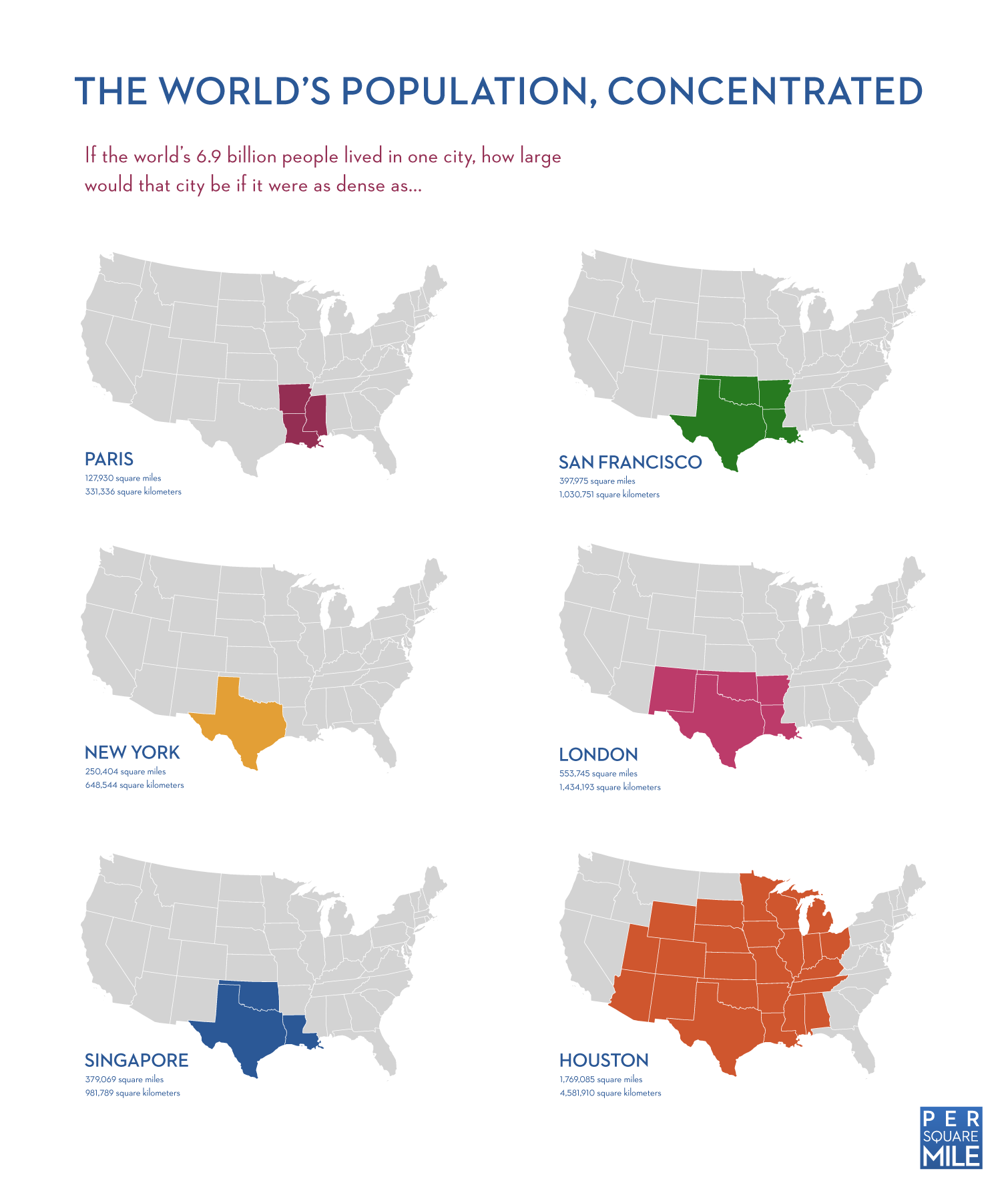
Overpopulation? Not
HT to Cafe Hayek, I've been looking for this data some time now, and I finally found it. The ramifications in terms of recycling, landfill space etc in relation to this are interesting to think about.
http://persquaremile.files.wordpress.com/2011/01/the-worlds-population-concentrated.png
Thursday, July 21, 2011
Jobs for Data Scientists Explode Across The Market - NYTimes.com
Data scientist positions are outpacing demand growth for statisticians- 'data scientists' are typically more well rounded in terms of theoretical and applied statistical knowledge, programming & data hacking skills, and industry subject matter as opposed to traditional statisticians.
Friday, July 15, 2011
PSST- Regime Uncertainty?
From Cafe Hayek- a framework for discussing the debt ceiling, the deficit, the financial crisis, recession, & what to do about it:
"But if the decline in GDP growth and in the rate of employment are caused, not by a taste-driven increase in the demand for money but, instead, by a large enough disruption in what Arnold Kling calls "patterns of sustainable specialization and trade," then kicking up aggregate demand won't solve the problem. Neither kicking it up, or trying to, through monetary policy or through fiscal policy will work. The problem is not originally one of widespread inadequate demand. In thiscase, inadequate aggregate demand is a symptom; treating the symptom will not cure the disease and, indeed, will only worsen it.
Without venturing here an opinion on the underlying source of each and every recession throughout American history, I will express an opinion about the current recession: it is clearly the result of distorting government policies, regulatory and monetary, leading up to 2008 as well as of the symptom-treating policies since then that only worsen matters. (And not to mention yet other actual and threatened policies"
Wednesday, July 13, 2011
Walmart Express and Food Deserts
From the Knowledge Problem blog:
I think some people would like to blame 'food deserts' on profit oriented retailors and 'industrial agriculture'. But here we have an example where a big box retailer is being presented as a possible solution to the 'food desert' dilemma. It make sense that given the extensive hurdles to bringing healthy food to some markets (forgetting for a moment those barriers associated with production agriculture) such as minimum wages, risk,liability, the war on drugs, taxes, and the regulatory environment, that a company like Wal-Mart could leverage their supply chain and possibly make a profit where no one else can.
Of course, Wal-Mart is no clear capitalist hero. Many of these progressive policies that have contributed to 'food deserts' likely found their way on corporate lobbyists' to do list. The essence of rent seeking is to expend resources to carve out a secure niche in the tax and regulatory environment.
Sunday, July 10, 2011
Drovers CattleNetwork - Agsight: No speculators? No thanks! - Cattle News - Editorial, Grain & Cattle Markets, Current Stories
A great article on commodity market speculation
http://www.cattlenetwork.com/cattle-news/Agsight-No-speculators-No-thanks.html
Sent from my iPod touch
Saturday, July 09, 2011
Top #Obama Aid Calls For Deregulation of #GMO #Food
"Dr. Beachy asked the subcommittee to consider the unintended consequences of overly stringent regulations of biotech crops. These include creating the perception that the technology is unsafe and causing many developing countries to be reluctant to adopt the technology. He noted, "It (the regulatory process) has adapted poorly in response to the proven safety record and absence of adverse affect on the environment or on animal and human health of GE crops. It has not adapted to changes that have further enhanced the safety of the technologies; and it has not adapted to the needs of the market. The system needs attention, modification, and improvement if the U.S. and global agriculture communities and its consumers are to benefit from the investment in past and current science and technology that can impact agriculture and agriforestry."
Rethinking Regulations for Biotech Crops - http://www.truthabouttrade.org/news/editorials/trade-policy-analysis/18078-rethinking-regulations-for-biotech-crops
Rethinking Regulations for Biotech Crops - http://www.truthabouttrade.org/news/editorials/trade-policy-analysis/18078-rethinking-regulations-for-biotech-crops
Thursday, July 07, 2011
Review & Outlook: The Jobless Summer - WSJ.com
A very good piece on the minimum wage and the negative impacts on future income earning opportunities.
Saturday, July 02, 2011
A Picture of The Minimum Wage
Image Source: Mark Perry
http://mjperry.blogspot.com/2011/06/but-at-least-politicians-care-in-theory.html
http://mjperry.blogspot.com/2011/06/but-at-least-politicians-care-in-theory.html
Below is a summary of most of the research in this area. (this is a direct copy/paste from the U.S. Congress Joint Economic Committee Report '50 Years of Research on the Minimum Wage, 1995). Note, very few studies [Card (1992b), Card and Krueger (1994), and Katz and Krueger (1992)] empirically challenge the consensus that minimum wages make it harder for individuals to find jobs or that they suffer loss of employment as a result.
- The minimum wage reduces employment.
Currie and Fallick (1993), Gallasch (1975), Gardner (1981), Peterson (1957), Peterson and Stewart (1969). - The minimum wage reduces employment more among teenagers than adults.
Adie (1973); Brown, Gilroy and Kohen (1981a, 1981b); Fleisher (1981); Hammermesh (1982); Meyer and Wise (1981, 1983a); Minimum Wage Study Commission (1981); Neumark and Wascher (1992); Ragan (1977); Vandenbrink (1987); Welch (1974, 1978); Welch and Cunningham (1978). - The minimum wage reduces employment most among black teenage males.
Al-Salam, Quester, and Welch (1981), Iden (1980), Mincer (1976), Moore (1971), Ragan (1977), Williams (1977a, 1977b). - The minimum wage helped South African whites at the expense of blacks.
Bauer (1959). - The minimum wage hurts blacks generally.
Behrman, Sickles and Taubman (1983); Linneman (1982). - The minimum wage hurts the unskilled.
Krumm (1981). - The minimum wage hurts low wage workers.
Brozen (1962), Cox and Oaxaca (1986), Gordon (1981). - The minimum wage hurts low wage workers particularly during cyclical downturns.
Kosters and Welch (1972), Welch (1974). - The minimum wage increases job turnover.
Hall (1982). - The minimum wage reduces average earnings of young workers.
Meyer and Wise (1983b). - The minimum wage drives workers into uncovered jobs, thus lowering wages in those sectors.
Brozen (1962), Tauchen (1981), Welch (1974). - The minimum wage reduces employment in low-wage industries, such as retailing.
Cotterman (1981), Douty (1960), Fleisher (1981), Hammermesh (1981), Peterson (1981). - The minimum wage hurts small businesses generally.
Kaun (1965). - The minimum wage causes employers to cut back on training.
Hashimoto (1981, 1982), Leighton and Mincer (1981), Ragan (1981). - The minimum wage has long-term effects on skills and lifetime earnings.
Brozen (1969), Feldstein (1973). - The minimum wage leads employers to cut back on fringe benefits.
McKenzie (1980), Wessels (1980). - The minimum wage encourages employers to install labor-saving devices.
Trapani and Moroney (1981). - The minimum wage hurts low-wage regions, such as the South and rural areas.
Colberg (1960, 1981), Krumm (1981). - The minimum wage increases the number of people on welfare.
Brandon (1995), Leffler (1978). - The minimum wage hurts the poor generally.
Stigler (1946). - The minimum wage does little to reduce poverty.
Bonilla (1992), Brown (1988), Johnson and Browning (1983), Kohen and Gilroy (1981), Parsons (1980), Smith and Vavrichek (1987). - The minimum wage helps upper income families.
Bell (1981), Datcher and Loury (1981), Johnson and Browning (1981), Kohen and Gilroy (1981). - The minimum wage helps unions.
Linneman (1982), Cox and Oaxaca (1982). - The minimum wage lowers the capital stock.
McCulloch (1981). - The minimum wage increases inflationary pressure.
Adams (1987), Brozen (1966), Gramlich (1976), Grossman (1983). - The minimum wage increases teenage crime rates.
Hashimoto (1987), Phillips (1981). - The minimum wage encourages employers to hire illegal aliens.
Beranek (1982). - Few workers are permanently stuck at the minimum wage.
Brozen (1969), Smith and Vavrichek (1992). - The minimum wage has had a massive impact on unemployment in Puerto Rico.
Freeman and Freeman (1991), Rottenberg (1981b). - The minimum wage has reduced employment in foreign countries.
Canada: Forrest (1982); Chile: Corbo (1981); Costa Rica: Gregory (1981); France: Rosa (1981). - Characteristics of minimum wage workers
Employment Policies Institute (1994), Haugen and Mellor (1990), Kniesner (1981), Mellor (1987), Mellor and Haugen (1986), Smith and Vavrichek (1987), Van Giezen (1994).
References
Finds that an increase in the minimum wage from $3.35 to $4.65 over three years would increase the unemployment rate by less than 0.1% and the inflation rate by 0.2%.Adie, Douglas K. 1973. Teen-Age Unemployment and Real Federal Minimum Wages. Journal of Political Economy, vol. 81 (March/April): 435-441.
Friday, July 01, 2011
1 Million Dollars: Pennywise Pound Poor Deficit Reduction Ideas
Remember this scene from the Austin Powers movie?
A parity of our political leaders discussion of budget cuts and tackling the deficit? This especially reminds me of the political posturing we get from the right and the left (like in a recent NYT article) discussing cuts to farm subsidies. Cutting the entire farm program budget amounts to less than 1/2 of 1 % of total government spending. Given the problems with medicare and social security, it seems like it costs us more to simply discuss farm subsidies than what we will ever end up saving through cuts. Some groups like the EWG have spent a lot of resources tracking farm subsidy data. Why? I guarantee it is not a fiscally minded agenda. They are more concerned with politically correct agriculture than sustainable farms or government, and I guarantee if subsidies were redirected to organic and local backyard production, the EWG data base would probably go away while the deficit grows and the check is in the mail for wealthy special interests.
A parity of our political leaders discussion of budget cuts and tackling the deficit? This especially reminds me of the political posturing we get from the right and the left (like in a recent NYT article) discussing cuts to farm subsidies. Cutting the entire farm program budget amounts to less than 1/2 of 1 % of total government spending. Given the problems with medicare and social security, it seems like it costs us more to simply discuss farm subsidies than what we will ever end up saving through cuts. Some groups like the EWG have spent a lot of resources tracking farm subsidy data. Why? I guarantee it is not a fiscally minded agenda. They are more concerned with politically correct agriculture than sustainable farms or government, and I guarantee if subsidies were redirected to organic and local backyard production, the EWG data base would probably go away while the deficit grows and the check is in the mail for wealthy special interests.
Tuesday, June 28, 2011
Do we get more energy out of ethanol than it takes to make it?
"Overall then, ethanol has made the transition from an energy sink, to a moderate net energy gain in the 1990s, to a substantial net energy gain in the present."
2008 Energy Balance for the Corn-Ethanol Industry. USDA
Monday, June 20, 2011
Friday, June 17, 2011
Regulating Commerce
Given the recent talk from the department of transportation regarding the possibility of requiring farmers and ranchers to have commercial drivers licenses, I thought I'd revisit some the flawed ideas related to the commerce clause. As it is, one of the regulator's primary concerns is if agricultural activity in this sense constitutes 'interstate commerce.'
In the case Wickard v. Filburn (1942) the Agricultural Adjustment Act (AAA) was found to be constitutional. This was on the basis that congress had a right to ‘regulate commerce.’
The power to ‘regulate commerce’ can be found article 1 Section 8 of the constitution. It is listed as one of the enumerated powers of the constitution:
‘To regulate Commerce with the foreign Nations, and among the several States, and with the Indian Tribes;’
In this case a farmer’s crop was being taxed because he produced more than was allowed under the AAA. His defense was that the federal government had no power or business telling him what he could grow on his private property in his state.
The court concluded that even though his crop was grown on his land in his state, it was possible that after he sold it, it could be marketed with grain harvested by other producers across the country. As a result this was considered ‘interstate commerce’ and could be regulated or taxed. The court did not give any more specific definition of ‘interstate commerce’ and set a precedent that if an activity could be considered ‘interstate commerce’ in theory, then it was subject to federal jurisdiction.
Was the court’s decision consistent with what was written in the constitution and our founder’s intentions? How broad did they interpret the power to regulate commerce?
What was meant by regulating congress among the several states?
In Federalist # 45 we read the following:
‘The powers delegated by the proposed constitution to the federal government are few and defined. Those which are to remain in the state governments are numerous and indefinite.’
‘The powers reserved to the several states will extend to all the objects which, in the ordinary course of affairs, concern the lives, liberties, and properties of the people and the internal order, improvement, and prosperity of the state.’
It appears here that our founders never intended for the federal government to be very involved with business and agriculture in the states. The Wickard interpretation is very broad. It does not seem consistent with the idea that the powers of the federal government are few or defined. It is obvious that this decision is contrary to our founder’s idea of limited government.
If we read Federalist # 41, six powers of the federal government are identified and explained. Two of these described the federal government’s relationship with regard to interstate commerce.
‘Maintenance and Harmony and proper intercourse among the states.’
‘Restraint of the states from certain injurious acts.’
To put this in context, after the American Revolution, some of the states were imposing tariffs on each other. The purpose of the interstate commerce clause was to prevent these kinds of ‘injurious acts’ so that trade and ‘proper intercourse’ could take place between the states. The founders never intended that the federal government should have the power to control every aspect of trade that occurred in or even between the states.
Given this history and the state of fear that our founders had of a powerful government, they would have never ratified the constitution if they thought ‘to regulate commerce’ meant congress would have the power to intervene in private business based on nothing more than a theoretical connection to interstate commerce. Wickard v Filburn lead to a huge expansion of power unanticipated by our founders, and a transfer of power away from the people and states without their consent.The purpose of the constitution was to ensure that the government did very little without the consent of the governed. Court cases like these leave us defensless.
As quoted from Ayn Rand’s book Atlas Shrugged ‘ …the government’s plans cannot be held up by the matter of your consent.’
Re-printed from my AgWeb post: http://www.agweb.com/blog/Economic_Sense_190/Regulating_Commerce_Agricultural_History_18256/
In the case Wickard v. Filburn (1942) the Agricultural Adjustment Act (AAA) was found to be constitutional. This was on the basis that congress had a right to ‘regulate commerce.’
The power to ‘regulate commerce’ can be found article 1 Section 8 of the constitution. It is listed as one of the enumerated powers of the constitution:
‘To regulate Commerce with the foreign Nations, and among the several States, and with the Indian Tribes;’
In this case a farmer’s crop was being taxed because he produced more than was allowed under the AAA. His defense was that the federal government had no power or business telling him what he could grow on his private property in his state.
The court concluded that even though his crop was grown on his land in his state, it was possible that after he sold it, it could be marketed with grain harvested by other producers across the country. As a result this was considered ‘interstate commerce’ and could be regulated or taxed. The court did not give any more specific definition of ‘interstate commerce’ and set a precedent that if an activity could be considered ‘interstate commerce’ in theory, then it was subject to federal jurisdiction.
Was the court’s decision consistent with what was written in the constitution and our founder’s intentions? How broad did they interpret the power to regulate commerce?
What was meant by regulating congress among the several states?
In Federalist # 45 we read the following:
‘The powers delegated by the proposed constitution to the federal government are few and defined. Those which are to remain in the state governments are numerous and indefinite.’
‘The powers reserved to the several states will extend to all the objects which, in the ordinary course of affairs, concern the lives, liberties, and properties of the people and the internal order, improvement, and prosperity of the state.’
It appears here that our founders never intended for the federal government to be very involved with business and agriculture in the states. The Wickard interpretation is very broad. It does not seem consistent with the idea that the powers of the federal government are few or defined. It is obvious that this decision is contrary to our founder’s idea of limited government.
If we read Federalist # 41, six powers of the federal government are identified and explained. Two of these described the federal government’s relationship with regard to interstate commerce.
‘Maintenance and Harmony and proper intercourse among the states.’
‘Restraint of the states from certain injurious acts.’
To put this in context, after the American Revolution, some of the states were imposing tariffs on each other. The purpose of the interstate commerce clause was to prevent these kinds of ‘injurious acts’ so that trade and ‘proper intercourse’ could take place between the states. The founders never intended that the federal government should have the power to control every aspect of trade that occurred in or even between the states.
Given this history and the state of fear that our founders had of a powerful government, they would have never ratified the constitution if they thought ‘to regulate commerce’ meant congress would have the power to intervene in private business based on nothing more than a theoretical connection to interstate commerce. Wickard v Filburn lead to a huge expansion of power unanticipated by our founders, and a transfer of power away from the people and states without their consent.The purpose of the constitution was to ensure that the government did very little without the consent of the governed. Court cases like these leave us defensless.
As quoted from Ayn Rand’s book Atlas Shrugged ‘ …the government’s plans cannot be held up by the matter of your consent.’
Re-printed from my AgWeb post: http://www.agweb.com/blog/Economic_Sense_190/Regulating_Commerce_Agricultural_History_18256/
Subscribe to:
Posts (Atom)