Monday, November 28, 2011

The New Deal and Enterprising Americans


One central theme behind Roosevelt's stimulus policies, like today, was that business was sitting on their hands and the government had to tax and spend to get things going and regulate to keep them going and prevent the next downturn. But as Chamberlain pointed out in his book Enterprising Americans: A Business History of the United States-

"the magnitude of the response of U.S. business to the war is in itself refutation of the thesis that in the thirties businessmen simply sat on thier hands…it simply would not have been able to produce the new type of goods when the war button was pressed"

While it was true that total investment was low, investment opportunities were proliferant. He points out the infinite number of industries ready to bust out with thier innovations, including such leaders as du Pont, Dow Chemical, American Cyanamid, and Monsanto that many in the ag industry would be familiar with. During this time GE was ready to go with flourescent lighting and Kodak with color photography and commercial air travel was in the making.

But these great ideas were suppressed and kept on the back burner under the massive interventions of Roosevelt's expanding government.

"Businessmen came to ask themseleves whether Roosevelt really understood a system where the hope of profit sparks expansion and investment. Or did he believe simply in centralizing decision and authority in boards and "planners" along the Potomac?"

Reference
The Enterprising Americans: A Business History of the United States
BY JOHN CHAMBERLAIN 1963

Saturday, November 26, 2011

Occupy Wall Street: Fighting the Right Fight?

Previously I had said “Time will tell if those occupying Wall Street calling for ending the Fed and crony capitalism are the true voice of the movement, or if they will ultimately find themselves tools for more interventionism through a progressive policy agenda.” With a recent article in the Washington Post, I think I’m starting to piece together an answer, at least from one protestor.


Take for instance the following quote:

"Only a soft regime change can end the pervasive corruption at the heart of our political system, in which corporate money wins elections, drafts laws and trumps citizen desires.”

How is it that corporate money wins elections, drafts laws, and trumps citizen desires? I've discussed previously the issue of disproportionate political power and abuse as it relates to extreme wealth and corporate influence. In short, its the nature of unrestrained democracy, not unrestrained capitalism. By granting government powers beyond those specifically enumerated in the constitution, progressive policies have represented bounty to be won by whoever can exert the most political muscle, as put by Public Choice Economist Dennis Mueller. If we are going to be concerned with the outlier that is the 1% of wealthiest Americans, our concern should be with those that achieved their wealth via progressive coercive political means as opposed to those that achieved it through socially cooperative means enriching the lives of multitudes. The ignorant short sighted prejudiced view of the 1% as being a homogenous group of thieves and manipulators is not enlightening.

The writer goes on:

" Only the plural voices of everyday Americans, the 99 percent, have the capacity to wake up the 1 percent to their greedy, self-serving ways, and to dismantle the global casino in which $1.3 trillion worth of derivatives, credit default swaps and other financial instruments slosh around every day without a hint of concern or regard for the millions of lives that such speculation can destroy."…And we will see clearly articulated demands emerging, among them … a move toward a “true cost” market regime in which the price of every product reflects the ecological cost of its production, distribution and use; and with a bit of luck, perhaps even the birth of a new, left-right hybrid political party that moves America beyond the Coke vs. Pepsi choices of the past."

While financial instruments may be difficult to understand, they are not bets made at the track or in a casino, they are tools for managing risk and directing capital to fill the most urgent needs of society based on the knowledge and preferences of multitudes of individuals, all giving their input via the price system. While not perfect, as the great economist Frederick Hayek put it, I would prefer imperfect prices over the pretense of knowledge. It was through the pretense of knowledge that the Federal Reserve’s actions in the social planning of money, interest, and housing ( ‘without a hint of concern or regard for the millions of lives that such speculation can destroy.’) that we got the financial crisis and the current recession. The idea of a ‘true cost market regime’ is an even more futile exercise in the pretense of knowledge. As I mentioned in a previous article, when we as a society fail to have the knowledge to determine the correct price and quantity of ice cream for our community or nation, how can we determine the correct price or quantity of carbon (or the ecological cost of any good for that matter)? Aren’t those sorts of calculations what would be necessary to implement a ‘true cost’ market regime? The command and control structure necessary to implement this (without a hint of concern or regard for the millions of lives that such speculation can destroy) would be demeaning to the millions in the 99% and empowering to the wealthiest and politically connected in the 1%. We’ve seen the effects of economics of scale in compliance in agriculture before. We saw how empowering the Markey-Waxman attempt to ecologically price carbon was to the worlds largest corporations.

I think through all of their rhetoric and their own model of direct democracy, many of the OWS crowd may confuse the virtues of the market with democracy. Unfortunately people think that there is something mystical and blessed about the end result of tallying votes. They fail to see how arbitrary this can be, and how poorly voting can work as a means to express and represent individual preferences about very specific issues that deal with the minute details of every day life and work. They confuse voting with the role and social function of the price system. What we need isn’t more democracy, or fascist price fixing regimes. What we actually need is more of the Coke vs. Pepsi choices of the past. I know the author was probably analogizing the little difference between political parties, but Coke vs. Pepsi is a great example of how empowering the price system is compared to the democratic decision making by two barely indistinguishable parties.  Anyone recall how empowering markets were to the 99% with regards to New Coke? How about more recently Netflix’s change in pricing structure? Agvocates are well aware of how empowering markets and social media were when it came to the corporate policies of Yellowtail and Pilot Travel Centers. Could you imagine having to implement these types of changes and  getting these responses through our political system or any number political parties? Of course not. Voting  is too blunt an instrument to do this.When we try to democratize these types of choices, votes are not empowering tools of democracy for the masses, they are empowering instruments for the politically connected 1%.  The answer isn't more voting or additional choices in political parties. The answer is as our founders put it, a republic if we can keep it, restrained from interfering with the minute details and choices of our every day lives.

So I conclude by asking, is the OWS movement really about empowering the masses, or will they ultimately find themselves tools for more interventionism through a progressive policy agenda? If the movement is more concerned about wealth redistribution and things like ‘true cost’ market regimes, they are fighting the wrong fight.

Friday, October 07, 2011

Occupy Wall Street: Hitching a Ride on the Tea Party Express?


The #occupywallstreet movement seems to be a pretty diverse group. From ‘trolling’ the occupywallstreet forums , there seems to be a big concern with corporatism, what economists would consider rent seeking- which is using the political apparatus to gain special favors (in terms of taxes, subsidies, or regulations) . There are also many concerned about the role of the Federal Reserve, which through the social planning of money and interest played a significant role in the financial crisis . And of course, many are rightfully upset over the bailouts. On most of these issues, if they are serious about their concerns, they find themselves practically standing hand-to-hand with the Tea Party. Then, on occasion you will find some listing demands for things like living wages, tariffs, and increased regulation, a Buffet style tax and other progressive end policies. So, you’ve got people within the same movement coming from entirely polar extremes, all converging on Wall-Street with a beef.  While nothing seems official, you can’t help but notice two major themes- 1) a call for getting the money out of politics and 2) class warfare between the top 1% (in income or wealth) and the other 99%. 

Last week, I presented an exhaustive look at the facts related to the distribution of income and taxes paid by the highest income earners. The facts showed that that the wealthy actually do pay more in taxes than their ‘secretaries’ and that the income gains over the last few decades have not gone mostly to the rich. (I have actually added even more to the evidence on my principles of economics blog here). But what about the top 1%?

First off, the top concern should not be the disparity of income or wealth in any society, but the process that generates that outcome. As the data I presented last week indicates, the process in the U.S. allows lots of movement and economic mobility. We want to be careful not to destroy a process that improves the lives of the countless Americans to achieve some idealistic imaginary snapshot of the wealth or income distribution.  Any coercive action by government to impose such a vision on society comes at great costs, borne most heavily by the very people we intend to help. (take for instance,  the minimum wage). So based on the facts and evidence alone, wealth concentration in a free society is a moot point. In fact, a free society that produces unequal shares of income and wealth (including people like Bill Gates, the late Steve Jobs, and the numerous unspoken entrepreneurs) is the kind of society able to deliver a lifestyle and opportunities to the masses.

But, if class warfare is the end in itself, it is interesting to ask, just how much wealth do the top 1% of wealthiest Americans control? Depending on your source you can get different results. According to one source, the top 1 % of Americans (in terms of wealth)  ‘control’ about 20-25% of the nation’s wealth. Another source indicates that they ‘control’ closer to 40%.   But, again, when we look back over the last century, we don’t observe any drastic increase in the concentration of wealth. Whatever the correct number, the idea that the wealthiest Americans control any proportion of the nations wealth is a bit elusive. It might be better to state that the top 1% of wealthiest Americans are connected to 40% of the nations wealth. 

Of course, if we were talking about King Henry the VIII, or Adolph Hitler, or Joseph Stalin, we might correctly say that these people controlled vast amounts of resources vital to the well being of millions of their citizens. However, if you are a wealthy individual that owns as part of your vast wealth a large amount of Netfilix’ stock, what would you say you are in control of? Given the recent drastic plunge in its value, wouldn’t you say that although you were connected to that vast wealth, it is subject to the individual decisions of multitudes of consumers and other investors? The simple fact is, no matter what the asset, owning an asset (be it stocks, collectible sports cars, beach homes, yachts, or Scrooge McDuck’s Money Bin) entails opportunity costs.  Those opportunity costs arise as a direct result of other people’s desires and interest in owning or having access to those resources.  Maybe you own a ton of real estate in shopping centers. That is meaningful only as long as the rest of society values shopping centers. (Again, just ask Coca Cola when they changed their formula, Netflix when they changed their pricing structure, or Blockbuster before them). This is in fact why we have so much mobility in the income and wealth distribution as shown in the data! As my economics professor taught long ago, we the poor college students, were able to outbid wealthy people every day in the ordinary transactions of buying and selling.  One of the most basic principles of economics is that prices force you to consider the impacts of your choices on others. When it comes to allocating resources in society, the market is the great equalizer. Appealing to class warfare by dividing society into fractions of 1 & 99 really gets us nowhere.

Of course, we may agree that when the top 1% (along with corporations and special interests) use their wealth to influence politics the free society paradigm breaks down. In fact, many of the protestors on Wall Street agree with the idea that ‘a democratic government derives its just power from the people… and that no true democracy is attainable when the process is determined by economic power. ‘  
As public choice economist Dennis Mueller is quoted in the article Public Choice Revolution:

"Interest groups will engage in what public choice theorists call “rent seeking,” i.e., the search for redistributive benefits at the expense of others. The larger the state and the more benefits it can confer, the more rent-seeking will occur. The entire federal budget...can be viewed as a gigantic rent up for grabs for those who can exert the most political muscle.”

 Our founders were well aware of these issues as stated in Federalist #10:

"From the protection of different and unequal faculties of acquiring property, the possession of different degrees and kinds of property immediately results; and from the influence of these on the sentiments and views of the respective proprietors, ensues a division of the society into different interests and parties."

-like the 1% and the 99%?

In Federalist #10 they also warned us about the populist appeals and uprisings that may result, but proposed a solution:

“A rage for paper money, for an abolition of debts, for an equal division of property, or for any other improper or wicked project…we behold a republican remedy for the diseases most incident to republican government.”

But the solution is not more government control through regulation of redistributive Buffet taxes. The problem of money in politics is excessive democracy, not lack of democracy.  The remedy proposed by the founders is embodied in a constitution, with specifically enumerated powers, not true democracy as quoted by the occupiers on Wall Street. If we look at the many powers of government today, how many were transfers of power away from the people by avoiding the amendment process or via crazy court decisions (like Helvering vs. Davis or  Wickard v. Filburn)  The purpose of the constitution was to ensure that the government did very little without the consent of the governed.  For the most part, that was achieved through legislation held in the strict bounds of enumerated powers, with expanded powers of government coming through the amendment process.  This strict adherence to constitutional principles was the foundation for a workable democratic constitutional republic, as stated by Economist Thomas Sowell in  Judicial Activism Reconsidered,

“The federal Constitution is "the supreme law of the land," not because it is more moral than state constitutions or state or federal legislative enactments, but because it represents a larger and more enduring majority. Minorities receive their constitutional rights from that enduring majority to which transient majorities bow, not from whatever abstract moral rights are imagined to exist as a brooding omnipresence in the sky.”

Democracy, limited by strict adherence to constitutional principles meant that government would have few powers and resources to spend on corporate interests, or progressive objects of benevolence.   As Thomas Jefferson stated:

“in questions of power then, let no more be heard of confidence in man, but bind him down from mischief by the chains of the constitution”

 If the occupiers are seriously concerned about money in politics, then, once again, they should find themselves in lockstep with the Tea Party in calling for a return to constitutional principles and limited government.  Time will tell if those occupying Wall Street calling for ending the Fed and crony capitalism are the true voice of the movement, or if they will ultimately find themselves tools for more interventionism through a progressive policy agenda.

Thursday, October 06, 2011

The CPI Couldn't Keep Up With Steve Jobs

From basic principles of economics, we know that measures of inflation based on the CPI are biased because of substitution effects, the introduction of new goods and services, and unmeasured quality changes.

Here is some related insight from Russ Roberts post Stagnation or Mismeasurement at Cafe Hayek: (this was in 2007)

 It is not just a question of the number of new goods and services–it is the pace of innovation  within product categories and how much each of these makes it hard to measure prices with any accuracy....The iPod will be six years old next month. The newly released iPod Classic with 160 GB of memory is $50 cheaper than the original iPod, holds 40 TIMES more songs and also plays color videos and displays photos. It is smaller, lighter and has a better battery.

Sunday, October 02, 2011

What You Mean By Big Ag

Are you confusing 'big ag', 'factory farming' or 'industrial agriculture' with the complex network of modern family farms, biotechnology companies, food processors, and retailers that cooperate to bring healthy and sustainable food to your table?

Saturday, September 24, 2011

The Buffet Tax Deception


"It is no crime to be ignorant of economics, which is, after all, a specialized discipline and one that most people consider to be a 'dismal science.' But it is totally irresponsible to have a loud and vociferous opinion on economic subjects while remaining in this state of ignorance." - Murray Rothbard Making Economic Sense (1995)

Should we really be talking about national tax policies based on the random, anecdotal observations of a celebrity businessman? Recently there has been a lot of talk from the media, politicians, and other commentators about a ‘Buffet Tax’ to ensure that billionaires pay their fair share of taxes. The battle cry comes from comments by very successful businessman and investor Warren Buffet, who claims that his secretary pays more in taxes (as a percent of income) than he does.  There are also claims that income for middle Americans has stagnated, while the wealthiest Americans have enjoyed most of the gains in income growth over the last decade. This is a long post, but the short of it is that these claims may sound good politically, and make great headlines for the media, but they don’t stand squarely with the facts.

Let’s look at the first claim. Do billionaires really pay less in taxes as a percent of income than their secretaries? 


Source: http://www.cbo.gov/ftpdocs/88xx/doc8885/EffectiveTaxRates.shtml  Historical Effective Federal Tax Rates: 1979 to 2005 Congressional Budget Office

Since these rates have not changed in the last 5 years, these numbers are still relevant, and show that historically the rich (like Warren Buffet) have always paid more. In fact, when it comes to ‘fairness’, the U.S. has one of the most progressive (meaning the rich pay more) tax systems in the world (see the data here at the Tax Foundation).  Sure it is possible that with the correct shelters/loopholes/wealth management, a wealthy person like Buffet could actually end up paying lower overall rates than their secretary. However, what the data shows is that overall, on average, the rich do pay more, with only a few rare and random cases like Buffet paying rates similar to or less than working class Americans. This brings up many questions. Why make major changes in the tax code that will affect millions to address the very few Warren Buffets of the world? Some would say to be ‘fair’ but as noted above, we already lead the world in terms of tax fairness based on income and the rich are already paying more. In terms of all income taxes collected by government, the wealthiest Americans pay most of the taxes.

The top 10% of earners make up about 10% of all households earn about 40% of all income, but pay 55% of all taxes (way more than their proportional share of income). The top 1% of earners make up only about 1% of households, earn about 18% of all income, but pay almost 30% of all taxes, again more than their share of national income.

Source: http://www.cbo.gov/ftpdocs/88xx/doc8885/EffectiveTaxRates.shtml  Historical Effective Federal Tax Rates: 1979 to 2005 Congressional Budget Office


No matter how you slice the data, there is no way you can claim that the rich are not paying ‘their fair share’ of taxes. (Note this is even after the tax cuts in the early this decade)

Another myth related to this, is that income for middle Americans has stagnated, while the wealthiest Americans have enjoyed most of the gains in income growth over the last decade. Again, this is not supported by the data. The first problem is that commentators and politicians with axes to grind typically refer to the ‘median household income’ to represent ‘middle class.’   While using the median is statistically more robust (less biased) than just the average when it comes to skewed income data, using median household income is still inappropriate. As economists Thomas Sowell and Russ Roberts explain clearly here (video) and here, households have changed tremendously over time, and really aren’t comparable over time. But there are even more reasons why median household income can be misleading.  Researcher Steve Conover points out in a recent article at the American Enterprise Institute’s American magazine, just looking at the median to define middle class is a very restrictive definition. After assembling data on income over the last decade based on data from the US Census Bureau and the Bureau of Labor Statistics, Conover developed several definitions of ‘middle class.’  No matter how many different ways we could define ‘middle class’ when we actually look at data on income gains over the last few years, we find in fact that the middle class income gained much more than the top 20% of earners, while the top 5% actually lost.


  Source: The Myth of Middle-Class Stagnation, Steve Conover

Of course, if we are concerned about the distribution of income in society, the important thing isn’t so much who’s gaining in which category, but instead its how often people move up and improve their standard of living.  After all, the American dream is not based on how much the rich pay in taxes vs the poor, or who gets the biggest piece of the pie. The American dream is about going out and getting your own piece of pie, or in other words, income mobility.  As economist Steve Horowitz explains in this video, even if you insist on looking at ‘median’ income earned by ‘households’ vs. individuals, when we look at the data, and follow these people over time, we see lots of income mobility as they move from one part of the income distribution to another.  The data shows that income mobility in the U.S. has been very robust.    As reported in the U.S. Treasury report Income Mobility in the U.S. from 1996 to 2005:

"Economic growth resulted in rising incomes for most taxpayers over the period from 1996 to 2005. Median incomes of all taxpayers increased by 24 percent after adjusting for inflation. The real incomes of two-thirds of all taxpayers increased over this period. In addition, the median incomes of those initially in the lower income groups increased more than the median incomes of those initially in the higher income groups. The degree of mobility in the overall population and movement out of the bottom quintile in this study are similar to the findings of prior research on income mobility."

So, we’ve debunked the myth that the wealthiest Americans aren’t paying there fair share, we’ve shown that middle class Americans have received significant gains in income over the last decade, and that income mobility in the U.S. is a reality. What other excuses can we/they come up with to raise taxes? One might claim that this is necessary to increase revenues, or reduce the budget deficit. In a previous post I’ve already shown how revenues actually increased while the budget deficit drastically dropped after the Bush tax cuts.  Quite a bit of additional research actually shows that higher income individuals are extremely sensitive to tax increases, and that tax increases can contribute to decreased job creation and investment. 

Were it not for the recession, the data shows that the middle class and the American dream was thriving. Instead of focusing on class warfare inspired non-issues (at least when it comes to real data), the media, commentators and our law makers should focus on the real issues at hand, chiefly the regulatory climate and the uncertainty  (as mentioned last month) that it is creating. Besides being based on bad evidence and false perceptions, a ‘Buffet’ tax could also be detrimental to the economy and such talk only adds to the cloud of uncertainty preventing us from getting out of the current economic rut.


Monday, September 05, 2011

Homeland Security, The Knowledge Problem & Constitution Week


Below are excerpts from two economists (David Henderson and Sam Clovis) on faculty at the Naval Post Graduate School. Note, Henderson will be speakingat WKU this year during Constitution Week. (special thanks to the BB&T Center For the Study of Capitalism at WKU).

"Central economic planning can't work, explained Hayek, because no small number of people at the top, however brilliant or informed, can aggregate all the trillions of pieces of data needed to plan an economy well. The main information that matters in real time is what Hayek called "knowledge of particular circumstances of time and place" and this information is necessarily decentralized: it exists only fleetingly in the minds of millions of people.....Hayek's argument applies whether the good being produced is food, steel, or internal security. In fact, in her testimony before the 9/11Commission, Dr. Rice explained the problems with centralization eloquently;


                  You have thousands of pieces of information . . . and you have to depend to a certain degree on the intelligence agencies to tell you what is actually relevant,

                 what is actually based on sound sources, what is speculative. 

The lesson of September 11 is not that government should plan better and not that a Republican president plans better or worse than a Democrat president. The lesson of 9/11 is that central planning doesn't work and that government should not get in the way of our planning. "  LINK


In addition to the  'knowledge problem' discussed above, Sobel and Leeson have identified several other issues with the top down approaches in homeland security regarding incentives, the tragedy of the anticommons, and type II error policy bias. Absent market prices, how do we deal with these issues? Attempts to address these problems, to some extent, can be found in scholarship related to homeland security and federalism:


"an agency that forms partnerships with state and local governments instead of coercive top-down regulation-heavy regimes is an appropriate response on the part of the national government to deal with the particular needs of all the other governments in this country. Further, this agency should work at giving state and local governments as much flexibility as possible in dealing with own-source challenges. By facilitating cooperative networks of communities/jurisdictions a far more realistic and pragmatic approach to all hazards preparedness is a logical outcome. The national government should provide the organization around which such networking might take place." –Homeland Security Affairs VI, no. 2 (May 2010) – Sam Clovis


Efficient Markets and Prices


‎"I prefer true but imperfect knowledge, even if it leaves much indetermined and unpredictable, to a pretence of exact knowledge" - F.A. Hayek
"The financial crisis invalidated a naïve notion of "efficient markets," but the most sophisticated version is still viable. Whereas the invalidated version holds that markets never err and always adjust instantaneously, the sophisticated version, associated with the ideas of Adam Smith and F. A. Hayek, holds that markets mobilize individuals to realize gains from trade and to innovate and thereby produce generalized prosperity."
"In the 1940s, Hayek warned his fellow economists of the misleading standards of perfect competition and static efficiency in assessing the market economy. As he wrote in Individualism and Economic Order, "[T]hese adjustments are probably never 'perfect' in the sense which the economist conceives them in his equilibrium analysis. But I fear that our theoretical habits of approaching the problem with the assumption of more or less perfect knowledge on the part of almost everyone has made us somewhat blind to the true function of the price mechanism and led us to apply rather misleading standards in judging its efficiency" (1948, 87)"


"The great free market economic thinkers from Adam Smith to F. A. Hayek never argued that individuals were hyper-rational actors possessed with full and complete information, operating in perfectly competitive markets.... Efficient markets are an outcome of a process of discovery, learning, and adjustment, not an assumption going into the analysis."

http://theeuropean-magazine.com/348-boettke-peter/349-the-legacy-of-smith-and-hayek


Friday, September 02, 2011

Taxes, Elasticity, Revenue, and Economic Activity

Romer, Christina and David Romer, (2010). "The Macroeconomic Effects of Tax Changes: Estimates Based on a New Measure of Fiscal Shocks," American Economic Review, vol. 100(3), pages 763-801.

tax increases to be highly contractionary with a negative effect on investment

Alesina, Alberto and Silvia Ardagna (2010) "Large Changes in Fiscal Policy: Taxes versus Spending" In Jeffrey Brown, 2010. "Tax Policy and the Economy, Volume 24," NBER Books, National Bureau of Economic Research.

Fiscal stimulis based on tax cuts increases the probability of future economic growth greater than spending


Carroll, Robert, Douglas Holtz-Eakin, Mark Rider, and Harvey Rosen (2000) "Income Taxes and Entrepreneurs Use of Labor," Journal of Labor Economics, 18 (2), April pp. 324-55

Increases in marginal tax rates reduce the probability of future increased hiring and are associaed with reduced growth in wages.

Gruber, Jon and Saez, Emmanuel, 2002. "The elasticity of taxable income: evidence and implications," Journal of Public Economics, vol. 84(1), pages 1-32.

Finds a very elastic response for incomes over $100k, (.57) with an elasticity of about .17 for incomes < $100k.

Gentry, William and Glenn Hubbard (2000) "Tax Policy and Entrepreneurial Entry" American Economic Review, vol. 90, pp. 283-287.

Finds a significant increase in entrepreneurial activity when tax rates are less progressive.

Djankov, Simeon, Tim Ganser, Caralee McLiesh, Rita Ramalho, and Andrei Shleifer, (2010). "The Effect of Corporate Taxes on Investment and Entrepreneurship," American Economic Journal: Macroeconomics, vol. 2(3), pages 31-64, July.American Economic Association.

"our estimates of the effective corporate tax rate have a large adverse impact on aggregate investment, FDI, and entrepreneurial activity"

The Effect of Marginal Tax Rates on Taxable Income: A Panel Study of the 1986 Tax Reform Act Martin Feldstein Journal of Political Economy
Vol. 103, No. 3 (Jun., 1995), pp. 551-572

Estimates the elasticity of taxable income to range from about 1.0 -3.

Lindsey, Lawrence B. 1987. "Individual Taxpayer Response to Taxcuts, 1982-1984." J. of Public Economics 33 (July) 173-206

Found elasticity of taxable income by income category to be .728 for income > $50k, 1.023 for >$100k, 1.413 for >$250k, and 2.0 for > $1 million. Also derived the tax revenue responses to reductions in marginal taxes for those earning more than $200k / yr. Revenues increased by 19% in 1982, 35% in 1983, 56% in 1984.

WHY DO EUROPEANS WORK (MUCH) LESS? IT IS TAXES AND GOVERNMENT SPENDING
Economic Inquiry, 2008, vol. 46, issue 2, pages 197-207

And

Why Do Americans Work So Much More Than Europeans?
Federal Reserve Bank of Minneapolis Quarterly Review
Vol. 28, No. 1, July 2004, pp. 2–13

Finds that taxes, and particularly higher marginal tax rates have a negative effect on labor hours.

Saturday, August 20, 2011

Rent Seeking and Biotechnology

"Yet today we have only a handful of genetically modified crops, primarily soybeans, corn, canola and cotton. All are commodity crops mainly used for feed or fiber and all were developed by big biotech companies. Only big companies can muster the money necessary to navigate the regulatory thicket woven by the government's three oversight agencies: the E.P.A., the Department of Agriculture and the Food and Drug Administration."


Monday, August 15, 2011

AgBiotech combating climate change « The Berkeley Blog

http://blogs.berkeley.edu/2011/08/14/agbiotech-and-combating-climate-change/

Some teasers:

"GMOs in the US and in other countries, reduce significantly the use of rather toxic pesticide chemicals and there is evidence that they actually save significant amount of lives in India and China. "

"It is easy to show that if restrictions on the adoption of GMOs would have been removed and adoption rates of GM varieties in Europe would have been similar to the observed patterns of adoption, then much of the recent increase in commodity food prices would have been diminished. Introduction of GM varieties to wheat and rice would have further reduced commodity prices whereby helping the poor and would have released resources for other uses."

"The land use saving effect of GM varieties is estimated to have the equivalent effect of taking between 800,000-9 million passenger cars off of the road....The use of herbicide-tolerant varieties enable large scale adoption of low-tillage practices that sequester carbon and greenhouse gas sequestering effect is estimated to be equal to that of taking 6.4 million cars off the road."

"The heavy regulation of GMOs are unsound not only because of the loss of benefits from existing varieties, but because of the loss of potential benefits from newer applications of GMOs"

Sunday, August 14, 2011

Greg Mankiw's Blog: What nation has the most progressive tax system?

Based on these numbers, the U.S. has the most progressive tax system in the world by far.

The top 10% of earners earn about 33.5% of all income on the U.S. but pay 45.1% of taxes. They in essence pay 35% more in taxes than what they earn as a share of income.

There is also an interesting discussion on how these numbers are used and interpreted.

http://gregmankiw.blogspot.com/2011/03/what-nation-has-most-progressive-tax.html

Saturday, August 13, 2011

The Economics of the S&P Downgrade


“the downgrade reflects our view that the effectiveness, stability, and predictability of American policymaking and political institutions have weakened at a time of ongoing fiscal and economic challenges to a degree more than we envisioned when we assigned a negative outlook to the rating on April 18, 2011”

One of the main reasons that the ‘multiplier’ effects of the stimulus have not taken hold, and the reason that the economy is recovering so sluggishly is the uncertainty in the regulatory environment. Last fall, NCBA president Steve Fogelsong put this quite well in an interview on Agritalk where he discusses the regulatory zeal including cap and trade, the takeover of the financial and auto industry, the student loan industry, dust regulation, inheritance taxes, failure of pending free trade agreements, as well as livestock marketing regulations to name a few (at 9:23 on the clip you can find here

A very similar argument  is also well put in a post on the economics blog Café Hayek:

"But if the decline in GDP growth and in the rate of employment are caused, not by a taste-driven increase in the demand for money but, instead, by a large enough disruption in what Arnold Kling calls "patterns of sustainable specialization and trade," then kicking up aggregate demand won't solve the problem.  Neither kicking it up, or trying to, through monetary policy or through fiscal policy will work.  The problem is not originally one of widespread inadequate demand…. it is clearly the result of distorting government policies, regulatory and monetary, leading up to 2008 as well as of the symptom-treating policies since then that only worsen matters.  (And not to mention yet other actual and threatened policies)”

The issue of regulatory uncertainty is not unique to our current economic challenges, we had a very similar situation following the Great Depression, which lasted for over a decade. According to Robert Higgs, this was largely the result of New Deal Policies that created regulatory uncertainty prolonging the depression. You can find his paper here. You can also find a good discussion of this work  on the EconTalk podcast here.


I’ve shared a lot of the following research in the past discussing the prediction that the stimulus probably would not work, but given the recent downgrade in the U.S. credit rating, it seems like it is worth a review:

"The Keynesians had it all wrong. In the Great Depression, employment was not low because investment was low. Employment and investment were low because labor market institutions and industrial policies changed in a way that lowered normal employment." --Edward C. Prescott Federal Reserve Bank of Minneapolis Quarterly Review Winter 1999, vol. 23, no. 1, pp. 25–31

"We find that New Deal cartelization policies are an important factor in accounting for the failure of the economy to recover back to trend." -Journal of Political Economy, 2004, vol. 112, no. 4 New Deal Policies and the Persistance of the Great Depression : A General Equilibrium Analysis. Harold L. Cole and Lee E. Ohanion.

"We conclude that a new shock is needed to account for the Depression’s weak recovery. A likely culprit is New Deal policies toward monopoly and the distribution of income." ---The Great Depression in the United States From A Neoclassical Perspective Federal Reserve Bank of Minneapolis Quarterly Review Winter 1999, vol. 23, no. 1, pp. 2–24

"Businessmen came to ask themseleves whether Roosevelt really understood a system where the hope of profit sparks expansion and investment. Or did he believe simply in centralizing decision and authority in boards and "planners" along the Patomac?" ---The Enterprising Americans: A Business History of the United States BY JOHN CHAMBERLAIN INSTITUTE FOR CHRISTIAN ECONOMICS TYLER, TEXAS 

Until we can start thinking outside the box of Keynesian economic policies as well as get a handle on the uncertain regulatory environment, we won’t likely see a strong recovery. That means higher budget deficits and downward pressure on future credit ratings.

For a more entertaining look at policy alternatives, I highly recommend the following youtube videos:


Fear the Boom and Bust


New Research On Fair Trade Coffee

 The Problem with Fair Trade Coffee
By Colleen Haight.  Stanford Social Innovation Review Summer 2011 link


My field and analytical research has found that there are distinct limitations to the Fair Trade model.7 Perhaps the most serious challenge is the extraordinarily high price of coffee. “The market today is five times higher than when FLO entered the United States. The market’s at $2.50 (per pound for commodity coffee) today vs. the 40 cents or 50 cents (per pound) it was at in 2001,” says Dennis Macray, former director of global sustainability at Starbucks Coffee Co. This price shift dampens farmers’ desire to sell their high-quality coffee at the Fair Trade price. Many co-ops, according to Macray, are choosing to default on the Fair Trade contracts, so that they can do better for their members by selling on the open market. 

(HT to Knowledge Problem )

Monday, August 08, 2011

ScienceDirect - Ecological Economics : Impact of Bt cotton on pesticide poisoning in


A case of the internalization of negative externalities via technological change and market forces w/o taxes or  new regulations. 

Abstract

While substantial research on the productivity and profit effects of Bt cotton has been carried out recently, the economic evaluation of positive and negative externalities has received much less attention. Here, we focus on farmer health impacts resulting from Bt-related changes in chemical pesticide use. Previous studies have documented that Bt cotton has reduced the problem of pesticide poisoning in developing countries, but they have failed to account for unobserved heterogeneity between technology adopters and non-adopters. We use unique panel survey data from India to estimate unbiased effects and their developments over time. Bt cotton has reduced pesticide applications by 50%, with the largest reductions of 70% occurring in the most toxic types of chemicals. Results of fixed-effects Poisson models confirm that Bt has notably reduced the incidence of acute pesticide poisoning among cotton growers. These effects have become more pronounced with increasing technology adoption rates. Bt cotton now helps to avoid several million cases of pesticide poisoning in India every year, which also entails sizeable health cost savings.


Saturday, July 23, 2011

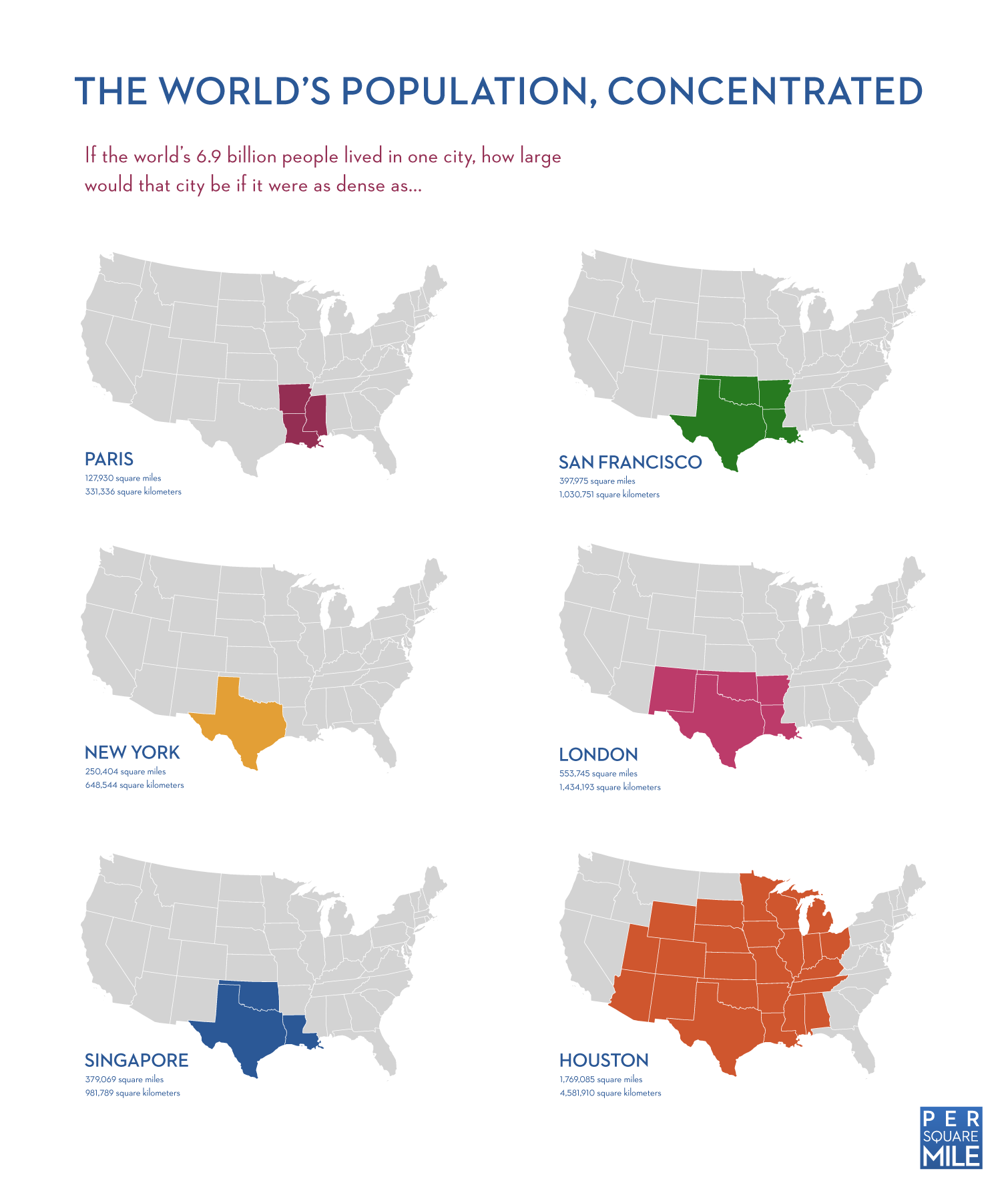
Overpopulation? Not

HT to Cafe Hayek, I've been looking for thus data a while. 


Overpopulation? Not

HT to Cafe Hayek, I've been looking for this data some time now, and I finally found it. The ramifications in terms of recycling, landfill space etc in relation to this are interesting to think about.

http://persquaremile.files.wordpress.com/2011/01/the-worlds-population-concentrated.png

Thursday, July 21, 2011

Jobs for Data Scientists Explode Across The Market - NYTimes.com

Data scientist positions are outpacing demand growth for statisticians- 'data scientists' are typically more well rounded in terms of theoretical and applied statistical knowledge, programming & data hacking skills, and industry subject matter as opposed to traditional statisticians.

http://www.nytimes.com/external/readwriteweb/2011/07/20/20readwriteweb-jobs-for-data-scientists-explode-across-the-91949.html

Friday, July 15, 2011

PSST- Regime Uncertainty?

From Cafe Hayek- a framework for discussing the debt ceiling, the deficit, the financial crisis, recession, & what to do about it:

"But if the decline in GDP growth and in the rate of employment are caused, not by a taste-driven increase in the demand for money but, instead, by a large enough disruption in what Arnold Kling calls "patterns of sustainable specialization and trade," then kicking up aggregate demand won't solve the problem.  Neither kicking it up, or trying to, through monetary policy or through fiscal policy will work.  The problem is not originally one of widespread inadequate demand.  In thiscase, inadequate aggregate demand is a symptom; treating the symptom will not cure the disease and, indeed, will only worsen it.

Without venturing here an opinion on the underlying source of each and every recession throughout American history, I will express an opinion about the current recession: it is clearly the result of distorting government policies, regulatory and monetary, leading up to 2008 as well as of the symptom-treating policies since then that only worsen matters.  (And not to mention yet other actual and threatened policies"


Wednesday, July 13, 2011

Walmart Express and Food Deserts

From the Knowledge Problem blog:

"If Walmart can leverage their supply chain logistics to bring their low-price model to these markets, this could expand the market while increasing competition, all of which benefits consumers. And, in a city like Chicago with low-income neighborhoods that qualify as "food deserts", a store like Walmart Express could provide retail access to fresh food in such areas."


I think some people would like to blame 'food deserts' on profit oriented retailors and 'industrial agriculture'. But here we have an example where a big box retailer is being presented as a possible solution to the 'food desert' dilemma. It make sense that given the extensive hurdles to bringing healthy food to some markets (forgetting for a moment those barriers associated with production agriculture) such as minimum wages, risk,liability, the war on drugs, taxes, and the regulatory environment, that a company like Wal-Mart could leverage their supply chain  and possibly make a profit where no one else can. 

Of course, Wal-Mart is no clear capitalist hero. Many of these progressive policies that have contributed to 'food deserts' likely found their way on corporate lobbyists' to do list. The essence of rent seeking is to expend resources to carve out a secure niche in the tax and regulatory environment.