There is a segment of the organic movement that wants to get their ducks in a row so that they can oppose gene editing technologies without hypocrisy. Quote:
“Without regulatory review” is bad enough. But to allow the use of mutagenesis, a process that involves “dousing seeds with chemicals,” in organic is a serious breach of consumer trust in the USDA organic certification program.”
Well no kidding. Not that I agree that this is a concern for safety, but its always been odd to me that recombinant DNA technologies would be ineligible for certified organic labeling (especially when Bt traits would make it much easier to exclude pesticides) while the gross number of other foods produced via mutagenesis were perfectly fine. Perhaps this cognitive dissonance was just fine until recent advances in gene editing technologies like CRISPR-Cas9. With the FDA taking comments regarding regulation of gene editing in new plant varieties, this is likely not a coincidence.
As I stated in my comments:
"Similar to organically certified crop varieties that use chemical and
radiological methods to create in-genome changes, gene edited
technologies operate within genome, vs. across species. (one popular
example of gene editing includes the CRISPR-Cas9 system).
Unlike mutagenic approaches used in organically approved plant breeding
systems, these in-genome tweaks are planned, controlled, and designed
to bring about very specific outcomes."
This presents a problem. Of course the page I have linked to does not explicitly state this as their rationale, you can't oppose new technologies that are actually more precise and safer than the old technologies you stand by unappologetically. (I realize in terms of safety we are splitting hairs but those hairs represent lots of money and marketing opportunities). So I don't blame this group for trying to get everyone on the same page. Another quote:
"How do you know if your organic food comes from mutant seeds? You don’t. If you buy local, you can ask your local farmer. Alternatively, you can avoid rice, wheat, barley, pears, cotton, peppermint, sunflowers and grapefruit. These are the only mutant crops that you could potentially find in the organic section."
Slim pickings if you want to oppose gene editing with integrity.
See also: Fat Tails, the Precautionary Principle, and GMOs.
Sunday, March 19, 2017


Friday, March 03, 2017
Positive Externalities and Spillovers of Conventional Food Production on Organic Food
Jayson Lusk recently pointed out that making large scale organic work (i.e. read if we want more access to organic food that means 'large scale') we need large scale conventional producers:
"Indeed, if one wants large scale organic, it almost certainly implies (given the current population) the need for large scale non-organic. All that life-supporting nitrogen has to come from somewhere. Until we find a better way, right now it is coming from Haber and Bosch and is smuggled into organic agriculture via animal manure. "
So organic thrives on positive externalities related to N use in conventional production.
Let's not forget the positive externalities of biotech traits....which not only help conventional producers use fewer pesticides but also help organic producers get by without sytnthetics:
Positive Externalities of Biotech Bt Traits on Non-Biotech Crops and Non Target Insects
Note: To be more precise, externalities represent uncompensated benefits so technically the benefits related to N use might not be true 'positive externalities.' The point is the importance of the interdependence between production systems that have been overlooked by a broader segment of the public.
Vance Crowe and Shark Farmer Discuss Ag Outreach and Communication
Previously the ag industry and companies like Monsanto seemed to have
a focus on a one-size fits all solution to crop protection and seeds.
Although research indicates significant diversity within species existed
in the age of hybrid corn, this was the era in which old school
arguments about monoculture probably dug in along with the other critcisms that go along with 'big ag.'
With the convergence of big data and genomics, row crop agriculture is transforming. Its not your grandparent's monoculture anymore. Companies like Monsanto are both positioning themselves to compete in this new environment and playing a major role in the transformation.
Recently I discussed an interview on the Closing Market Report with Robb Fraley, Chief Technology Officer at Monsanto and the kind of people they are hiring to help lead this transformation.
One challenge is, have those that have spent the last decade nostalgically and critically looking back at the way we used to do things missed this transformation? Will they be willing to embrace its benefits going forward.
This may be part of what Vance Crowe, Director of Millennial Engagement at Monsanto is trying to address in his role. Recently I discovered the Shark Farmer podcast, and Crowe was a guest in one of the archived episodes. One part of the conversation really got me interested. Here Vance is describing the challenge that he discovered during his job interview that made him really want the job he has:
"if the company is what everybody on the outside thinks it is then I get unfettered access...and if its not as dark as what people think it is then you have just stumbled upon one of the greatest problems of our age which is a really misunderstood company that is producing important technology that really has world changing impact that people really misunderstand"
I always wondered, how is it that people get so enamored with Apple and its great products or embrace hybrid car technology, self driving cars, or pay premiums for food at Chipotle and Whole Foods because they think they are doing great things for the environment while shunning Monsanto and all of its technologies which are basically cutting edge green technologies (see links below). One thing they discussed in the podcast (my description not their words) was that historically the Monsanto that catered to yesterday's agriculture and had an obvious focus on its customer core, farmers, but did not really market to or emphasize outreach to consumers. I think that is an important and informing observation to make. And I think the solution going forward is a gate to plate strategy of communication, outreach, and transparency to help consumers at all levels better understand the transformation that is going on with modern sustainable agriculture.
See also:
Shark Farmer Podcast
The Biotech Story: As told in the literature
The Convergence of Big Data and Genomics in Agriculture
Not Your Grandparent's Monoculture
Hybrid Corn vs Hybrid Cars
With the convergence of big data and genomics, row crop agriculture is transforming. Its not your grandparent's monoculture anymore. Companies like Monsanto are both positioning themselves to compete in this new environment and playing a major role in the transformation.
Recently I discussed an interview on the Closing Market Report with Robb Fraley, Chief Technology Officer at Monsanto and the kind of people they are hiring to help lead this transformation.
One challenge is, have those that have spent the last decade nostalgically and critically looking back at the way we used to do things missed this transformation? Will they be willing to embrace its benefits going forward.
This may be part of what Vance Crowe, Director of Millennial Engagement at Monsanto is trying to address in his role. Recently I discovered the Shark Farmer podcast, and Crowe was a guest in one of the archived episodes. One part of the conversation really got me interested. Here Vance is describing the challenge that he discovered during his job interview that made him really want the job he has:
"if the company is what everybody on the outside thinks it is then I get unfettered access...and if its not as dark as what people think it is then you have just stumbled upon one of the greatest problems of our age which is a really misunderstood company that is producing important technology that really has world changing impact that people really misunderstand"
I always wondered, how is it that people get so enamored with Apple and its great products or embrace hybrid car technology, self driving cars, or pay premiums for food at Chipotle and Whole Foods because they think they are doing great things for the environment while shunning Monsanto and all of its technologies which are basically cutting edge green technologies (see links below). One thing they discussed in the podcast (my description not their words) was that historically the Monsanto that catered to yesterday's agriculture and had an obvious focus on its customer core, farmers, but did not really market to or emphasize outreach to consumers. I think that is an important and informing observation to make. And I think the solution going forward is a gate to plate strategy of communication, outreach, and transparency to help consumers at all levels better understand the transformation that is going on with modern sustainable agriculture.
See also:
Shark Farmer Podcast
The Biotech Story: As told in the literature
The Convergence of Big Data and Genomics in Agriculture
Not Your Grandparent's Monoculture
Hybrid Corn vs Hybrid Cars
Thursday, February 23, 2017
Comments on Rules for Gene-Editing Technology
From the literature:
“We found that the improvement of a plant variety through the acquisition of a new desired trait, using either mutagenesis or transgenesis, may cause stress and thus lead to an altered expression of untargeted genes. In all of the cases studied, the observed alteration was more extensive in mutagenized than in transgenic plants” - (Batista, et al; 2008)
So what are the implications of this? Currently the FDA is accepting public comments related to genome editing in new plant varieties used for foods. https://www.regulations.gov/document?D=FDA-2016-N-4389-0001
Gene editing represents an opportunity to move forward with advanced technologies to sustainably feed the planet without the same regulatory hurdles that make development costs for transgenic plant varieties (aka GMO) up to 20x greater than conventionally bred plants(Conko and Miller, 2003). Similar to organically certified crop varieties that use chemical and radiological methods to create in-genome changes, gene edited technologies operate within genome, vs. across species. (one popular example of gene editing includes the CRISPR-Cas9 system). Unlike mutagenic approaches used in organically approved plant breeding systems, these in-genome tweaks are planned, controlled, and designed to bring about very specific outcomes. Gene edited plants are not ‘gmo’ in the manner that the term has traditionally been used (or misused) by regulatory proponents, and in fact are just as natural as their organically approved counterparts in terms of their development. However they stand out in very important and positive ways.
The article above (see also Baudo et al; 2006) does not specifically address gene edited plants, while it does indicate that genomic disruptions are greater in mutagenic plants vs standard transgenic plants. (one common argument for increased regulation related to transgenic crops has been based on the concern that the introduction of new genes can have unknown consequences and genomic disruptions are one way of characterizing this*) With greater disruptions, one might favor increased regulatory scrutiny similar to the existing framework in place for transgenics. However, we do not have a framework in place for mutagenically improved crop varieties that have been safely used for decades and approved by the organic food industry as well as consumers. Because both mutagenic and gene edited technologies represent similar in-genome approaches to crop improvement, this in fact argues against additional regulation for both mutagenic and gene edited plants, or it begs for the possibility of a revision of the existing regulatory framework for transgenics.
The benefits of gene editing technology offer far greater option value* than either conventional and organic mutagenically improved or even traditional ‘GMO’ or transgenic crops while the risks to human health and the environment are equally minimal. To impose new costly regulations on gene-edited plants would be to create huge hurdles for the development of next generation green technologies in food and fiber production in the United States and have significant environmental, public, and personal health implications for the rest of the world.
References:
Batista R, Saibo N, Lourenço T, Oliveira MM. Microarray analyses reveal that
plant mutagenesis may induce more transcriptomic changes than transgene
insertion. Proc Natl Acad Sci U S A. 2008 Mar 4;105(9):3640-5. doi:
10.1073/pnas.0707881105. PubMed PMID: 18303117; PubMed Central PMCID: PMC2265136
Baudo MM, Lyons R, Powers S, Pastori GM, Edwards KJ, Holdsworth MJ, Shewry PR. (2006). Transgenesis has less impact on the transcriptome of wheat grain than conventional breeding. Plant Biotechnol J. 2006 Jul;4(4):369-80
Henry Miller and Gregory Conko. Bootleggers and Biotechs. Regulation. Summer 2003
*this post has been modified to better clarify some posited arguments some have made for regulation of genetically modifed crop plants as well as to express the potential option value that gene editing might provide in addition to previously existing technologies. Special thanks to input via twitter from @CosmicHominid for constructive input
“We found that the improvement of a plant variety through the acquisition of a new desired trait, using either mutagenesis or transgenesis, may cause stress and thus lead to an altered expression of untargeted genes. In all of the cases studied, the observed alteration was more extensive in mutagenized than in transgenic plants” - (Batista, et al; 2008)
So what are the implications of this? Currently the FDA is accepting public comments related to genome editing in new plant varieties used for foods. https://www.regulations.gov/document?D=FDA-2016-N-4389-0001
Gene editing represents an opportunity to move forward with advanced technologies to sustainably feed the planet without the same regulatory hurdles that make development costs for transgenic plant varieties (aka GMO) up to 20x greater than conventionally bred plants(Conko and Miller, 2003). Similar to organically certified crop varieties that use chemical and radiological methods to create in-genome changes, gene edited technologies operate within genome, vs. across species. (one popular example of gene editing includes the CRISPR-Cas9 system). Unlike mutagenic approaches used in organically approved plant breeding systems, these in-genome tweaks are planned, controlled, and designed to bring about very specific outcomes. Gene edited plants are not ‘gmo’ in the manner that the term has traditionally been used (or misused) by regulatory proponents, and in fact are just as natural as their organically approved counterparts in terms of their development. However they stand out in very important and positive ways.
The article above (see also Baudo et al; 2006) does not specifically address gene edited plants, while it does indicate that genomic disruptions are greater in mutagenic plants vs standard transgenic plants. (one common argument for increased regulation related to transgenic crops has been based on the concern that the introduction of new genes can have unknown consequences and genomic disruptions are one way of characterizing this*) With greater disruptions, one might favor increased regulatory scrutiny similar to the existing framework in place for transgenics. However, we do not have a framework in place for mutagenically improved crop varieties that have been safely used for decades and approved by the organic food industry as well as consumers. Because both mutagenic and gene edited technologies represent similar in-genome approaches to crop improvement, this in fact argues against additional regulation for both mutagenic and gene edited plants, or it begs for the possibility of a revision of the existing regulatory framework for transgenics.
The benefits of gene editing technology offer far greater option value* than either conventional and organic mutagenically improved or even traditional ‘GMO’ or transgenic crops while the risks to human health and the environment are equally minimal. To impose new costly regulations on gene-edited plants would be to create huge hurdles for the development of next generation green technologies in food and fiber production in the United States and have significant environmental, public, and personal health implications for the rest of the world.
References:
Batista R, Saibo N, Lourenço T, Oliveira MM. Microarray analyses reveal that
plant mutagenesis may induce more transcriptomic changes than transgene
insertion. Proc Natl Acad Sci U S A. 2008 Mar 4;105(9):3640-5. doi:
10.1073/pnas.0707881105. PubMed PMID: 18303117; PubMed Central PMCID: PMC2265136
Baudo MM, Lyons R, Powers S, Pastori GM, Edwards KJ, Holdsworth MJ, Shewry PR. (2006). Transgenesis has less impact on the transcriptome of wheat grain than conventional breeding. Plant Biotechnol J. 2006 Jul;4(4):369-80
Henry Miller and Gregory Conko. Bootleggers and Biotechs. Regulation. Summer 2003
*this post has been modified to better clarify some posited arguments some have made for regulation of genetically modifed crop plants as well as to express the potential option value that gene editing might provide in addition to previously existing technologies. Special thanks to input via twitter from @CosmicHominid for constructive input
Transforming a Company for a New Kind of Agriculture (WillAg closing market report w/Robb Fraley))
Last week there was an interesting interview on the closing market report with Robb Fraley, Chief Technology Officer at Monsanto. The discussion related to possible future spending on R&D related to the potential merger with Bayer. Some interesting comparisons were made between R&D spending by Monsanto vs other research intensive industries like Samsung and Apple and pharma. The takeaway is that the combined company would have more resources to invest, and based on what is spent on R&D in other sectors there is a lot of untapped opportunity here that the combined companies could take advantage of.
I would love to know how much is spent on regulatory compliance given the extreme overkill in this area related to biotech making transgenic varieties cost as much as 20X more to develop vs conventional technologies. I'd like to know direct costs and indirect compliance costs in terms of lost revenue due to delays in approvals etc. One would wonder how much better these companies could serve the industry if those resources could be re-allocated to more productive R&D?
But to me the interesting question related to what kind of people are they looking to hire going forward? The answer included people working in or studying data science, engineers, mathematicians, statisticians. This is not a surprise to anyone following the industry, but its indicative of the kind of company that Monsanto has transformed and is transforming into. The phrase that stuck with me most was "breeding gene by gene and farming plant by plant".
The future direction, merger or not, is the integration of agronomy, bioechemistry, molecular biology, and data science to develop new products, solutions, and services that serve producers, consumers, and the planet as a whole. This is what I have written about before in terms of the convergence of big ag, genomics, and big data.
And this means more choices and opportunities going forward:
"the disruptions of new technology, big data and genomics (applications like FieldScripts, ACRES, MyJohnDeere or the new concept Kinze planters that switch hybrids on the go etc.) will require the market to continue to offer a range of choices in seeds and genetics to tailor to each producer's circumstances of time and place. There are numerous margins that growers look at when optimizing their seed choices and it will require a number of firms and seed choices to meet these needs as the industry's focus moves from the farm and field level to the data gathered by the row foot with each pass over the field." - From Big Data + Genomics ≠ Your Grandparent's Monoculture
References:
http://will.illinois.edu/closingmarketreport/program/feb-16-closing-market-report
Henry Miller and Gregory Conko. 'Bootleggers and Biotechs.' Regulation. Summer 2003
I would love to know how much is spent on regulatory compliance given the extreme overkill in this area related to biotech making transgenic varieties cost as much as 20X more to develop vs conventional technologies. I'd like to know direct costs and indirect compliance costs in terms of lost revenue due to delays in approvals etc. One would wonder how much better these companies could serve the industry if those resources could be re-allocated to more productive R&D?
But to me the interesting question related to what kind of people are they looking to hire going forward? The answer included people working in or studying data science, engineers, mathematicians, statisticians. This is not a surprise to anyone following the industry, but its indicative of the kind of company that Monsanto has transformed and is transforming into. The phrase that stuck with me most was "breeding gene by gene and farming plant by plant".
The future direction, merger or not, is the integration of agronomy, bioechemistry, molecular biology, and data science to develop new products, solutions, and services that serve producers, consumers, and the planet as a whole. This is what I have written about before in terms of the convergence of big ag, genomics, and big data.
And this means more choices and opportunities going forward:
"the disruptions of new technology, big data and genomics (applications like FieldScripts, ACRES, MyJohnDeere or the new concept Kinze planters that switch hybrids on the go etc.) will require the market to continue to offer a range of choices in seeds and genetics to tailor to each producer's circumstances of time and place. There are numerous margins that growers look at when optimizing their seed choices and it will require a number of firms and seed choices to meet these needs as the industry's focus moves from the farm and field level to the data gathered by the row foot with each pass over the field." - From Big Data + Genomics ≠ Your Grandparent's Monoculture
References:
http://will.illinois.edu/closingmarketreport/program/feb-16-closing-market-report
Henry Miller and Gregory Conko. 'Bootleggers and Biotechs.' Regulation. Summer 2003
Tuesday, February 21, 2017
The Biotech Story: As told in the scientific literature
Has biotechnology lived up to its promises? What were the ‘promises’ of
biotechnology? Does genetic engineering present food safety risks
greater than conventional plant breeding methods? These are
controversial questions. There is one version of the story that
indicates that biotechnology has not lived up to so called promises
expressed by critics and creates risks to the environment and consumers.
However the story that we find in the scientific literature tells us
that biotechnology in crop production and applications in the livestock
industry is just as safe or safer than traditional technologies,
promotes biodiversity, reduces the levels and toxicity of herbicides and
pesticides used in row crop production, improves food safety, and
reduces our carbon footprint. This annotated review of key scientific
papers from sources including The Proceedings of the National Academy of
Sciences, Science, Nature Biotechnology, Crop Science, Ecological
Economics, and others tells this story.
Matt Bogard. "The biotech story: as told in the scientific literature" (2017)
Available at: http://works.bepress.com/matt_bogard/35/
See also: Modern Sustainable Agriculture (video)
Matt Bogard. "The biotech story: as told in the scientific literature" (2017)
Available at: http://works.bepress.com/matt_bogard/35/
See also: Modern Sustainable Agriculture (video)
Tuesday, February 07, 2017
The progressive way to deny climate change
Julie Kelly makes an interesting point with this question:
"who are the real deniers: those who are reasonably skeptical about climate change or those who give lots of lip service to it while living a lifestyle totally inimical to every tenet of the climate change creed?"
A different but related argument is given by Steve Horwitz:
“It is perfectly possible to accept the science of global warming but reject the policies most often put forward to combat it. One can think humans are causing the planet to warm but logically and humanely conclude that we should do nothing about it. In fact, those who think they can go directly from science to policy are, as it turns out, engaged in denial”
This is not that different from what I have argued before. To me this is the fundamental problem of climate change:
Without being able to accurately predict future damages, or discount them to evaluate them in today's dollars, it's hard to value future climate related gains that today's sacrifices (driving less or smaller or hybrid cars, switching from coal fired electricity to natural gas or solar, changing our diet or other lifestyle changes, lost income or returns from capital investment etc.) will buy. In other words it's hard to know to what extent it makes any sense to do anything about climate change.
Bringing these perspectives together, some of the most ardent proponents of doing something about climate change based on 'science' are in denial about real world workable solutions:
Unfortunately, many of the same people so vocal about adopting policies based on the so called science of climate change (taxes, permits, dietary restrictions, regulations etc.) are also many of the same people that would restrict us (via GMO labeling laws, bans, strict limitations on hormone and antibiotic use, demonization of LFTB via derogatory terms like 'pink slime' etc.) from doing the very things that would have the greatest positive impact on our climate and environment.
So it seems we have some people that want to as Steve says, jump straight from the science to policy and skip over asking the hard questions or making a critical case for it. At the same time they are they are ignoring real world workable solutions, which are in fact based on solid science, if not actually trying to block them. For progressives of this flavor its not about science, its about invoking the name and prestige of science to override other people's choices while being in denial about rigorous evidence to support their position.
See also:
Doing Nothing: A science based policy prescription for climate change
Facts, Alternative Facts, Evidence, and Marching for Science
Science + Economics = Sound Policy
"who are the real deniers: those who are reasonably skeptical about climate change or those who give lots of lip service to it while living a lifestyle totally inimical to every tenet of the climate change creed?"
A different but related argument is given by Steve Horwitz:
“It is perfectly possible to accept the science of global warming but reject the policies most often put forward to combat it. One can think humans are causing the planet to warm but logically and humanely conclude that we should do nothing about it. In fact, those who think they can go directly from science to policy are, as it turns out, engaged in denial”
This is not that different from what I have argued before. To me this is the fundamental problem of climate change:
Without being able to accurately predict future damages, or discount them to evaluate them in today's dollars, it's hard to value future climate related gains that today's sacrifices (driving less or smaller or hybrid cars, switching from coal fired electricity to natural gas or solar, changing our diet or other lifestyle changes, lost income or returns from capital investment etc.) will buy. In other words it's hard to know to what extent it makes any sense to do anything about climate change.
Bringing these perspectives together, some of the most ardent proponents of doing something about climate change based on 'science' are in denial about real world workable solutions:
Unfortunately, many of the same people so vocal about adopting policies based on the so called science of climate change (taxes, permits, dietary restrictions, regulations etc.) are also many of the same people that would restrict us (via GMO labeling laws, bans, strict limitations on hormone and antibiotic use, demonization of LFTB via derogatory terms like 'pink slime' etc.) from doing the very things that would have the greatest positive impact on our climate and environment.
So it seems we have some people that want to as Steve says, jump straight from the science to policy and skip over asking the hard questions or making a critical case for it. At the same time they are they are ignoring real world workable solutions, which are in fact based on solid science, if not actually trying to block them. For progressives of this flavor its not about science, its about invoking the name and prestige of science to override other people's choices while being in denial about rigorous evidence to support their position.
See also:
Doing Nothing: A science based policy prescription for climate change
Facts, Alternative Facts, Evidence, and Marching for Science
Science + Economics = Sound Policy
Saturday, January 28, 2017
Facts, Alternative Facts, Evidence, and Marching for Science
From:
Scientists planning their own march in Washington (CNN Politics)
http://www.cnn.com/2017/01/25/politics/scientists-march-dc-trnd/index.html
"There are certain things that we accept as facts with no alternatives," according to the site. "The Earth is becoming warmer due to human action. The diversity of life arose by evolution. ... An American government that ignores science to pursue ideological agendas endangers the world."
While I could not agree more with this, one thing that concerns me especially since this last election is the extreme emphasis given to isolated facts vs critical thinking and evidence. Ideological agendas thrive on isolated facts. The real danger as economist Thomas Sowell points out in some of his writings is when an American government invokes the name and prestige of science to override other people's choices.
Take for example the following "facts" we often hear from activists in the agriculture space.:
1) Over the last two decades we have seen increased plantings of "GMO" crops resistant to roundup as well as weeds resistant to roundup herbicide.
2) GMOs have lead to increased use of chemicals in agriculture and that increases risks to health and the environment.
3) Industrial scale farms get subsidies from government to grow mostly monocrops of corn and soybeans which are primary ingredients going into cheap unhealthy foods at the same time we are seeing an obesity epidemic
And this fact from the article above:
4) The Earth is becoming warmer due to human action.
One could take these "facts" and then lobby for policies to address all of these concerns including increased regulation, carbon taxes, changing farm subsidies, labeling laws, or taxing foods. In every case we are pushing an agenda to override the choices of millions in the name of science, based on "facts". But there is a big difference between facts and evidence that supports one policy or another. When we consider each of these facts in the proper context, when we begin to think critically instead of ideologically, science based policy becomes something different. For instance, we know that roundup (or glyphosate) has largely replaced other chemicals much more toxic and persistent in the environment (USDA, 2000). We also know that monoculture and its implications for genetic diversity and sustainability are quite different than what popular stigmas imply. And finally, the links between farm subsidies, commodity crops and obesity are very very frail when we look at the actual impact these policies have on food prices or even the potential for things like soda taxes. But what about climate change? If we are going to make progress here we have to accept that it does not make one a climate change denier to understand that our response to climate change also has to be based on facts and evidence held to the same level of rigor and scrutiny as the science supporting its existence.
Economics teaches us that the world is complicated. There are numerous facts and details to consider when trying to solve a problem. While it is certainly bad for governments to deny the truthfulness of established facts based on sound science, we must also understand how to make sense of them. Economics provides a theory for deciding which facts are central and which are periphreal.* To quote Paul Heyne, Boettke, and David Prychiko in their text the economic way of thinking (10th ed) "we can observe facts but it takes a theory to explain causes. It takes theory to weed out the irrelevant facts from the relevant ones".
As I stated before economics can put science, good or bad, into a context relevant to the things we really care about.
So while I support a march for science and appreciate the driving concerns around politicians efforts to muzzle science, at the end of the day lets emphasize critical thinking and sound theory over isolated facts and talking points. While the "facts" stated in the article may have no alternatives, there are numerous alternatives with regard to the policies so called purveyors of truth may have in mind to address them. These policies imply numerous margins and tradeoffs to be considered. Only critical thinking, evidence, and sound theory can help us find the best path among many for addressing these issues. Economics provides mathematically precise theories and empirically sound methods that together provide a rigorous policy analysis framework for addressing these problems.
Isolated facts grounded in the truth of science but devoid of critical thinking about causal relationships and policy tradeoffs can be just as dangerous and little better than alternative facts that deny the truth of science.
It's probably also true that the truth of science can risk losing ground to alternative facts if not properly communicated. We know this when it comes to alternative facts about biotechnology that currently drive the snake oil marketing practices of many food companies and lobbying for related policies.
From what I can tell the March for Science is nonpartisan and its more about freedom of speech and science communication than taking a stance on one policy vs another, so I don't think they are attempting to recruit activists for one policy vs another. But the march for science could present an awesome opportunity for science communication about many of the issues in agriculture related to biotechnology, genomics, technology, and modern production practices that so often come under the radar of activists, politicians, and the media. Or, at least the chance to segway into conversation.
See also:
Diversity in Agricultural Production
Modern Sustainable Agriculture - Video with Annotated Bibliography
Genetically Engineered Crops: Has Adoption Reduced Pesticide Use? Agricultural Outlook ERS/USDA Aug 2000
*taken from Alan Stockman, Introduction to Marcoeconomics. 2nd Edition.
Left vs Right vs Propensity to Regulate http://ageconomist.blogspot.com/2016/06/left-vs-right-science-vs-risk-vs.html
Fat Tails, the Precautionary Principle and GMOS http://ageconomist.blogspot.com/2015/01/fat-tails-precautionary-principle-and.html
Scientists planning their own march in Washington (CNN Politics)
http://www.cnn.com/2017/01/25/politics/scientists-march-dc-trnd/index.html
"There are certain things that we accept as facts with no alternatives," according to the site. "The Earth is becoming warmer due to human action. The diversity of life arose by evolution. ... An American government that ignores science to pursue ideological agendas endangers the world."
While I could not agree more with this, one thing that concerns me especially since this last election is the extreme emphasis given to isolated facts vs critical thinking and evidence. Ideological agendas thrive on isolated facts. The real danger as economist Thomas Sowell points out in some of his writings is when an American government invokes the name and prestige of science to override other people's choices.
Take for example the following "facts" we often hear from activists in the agriculture space.:
1) Over the last two decades we have seen increased plantings of "GMO" crops resistant to roundup as well as weeds resistant to roundup herbicide.
2) GMOs have lead to increased use of chemicals in agriculture and that increases risks to health and the environment.
3) Industrial scale farms get subsidies from government to grow mostly monocrops of corn and soybeans which are primary ingredients going into cheap unhealthy foods at the same time we are seeing an obesity epidemic
And this fact from the article above:
4) The Earth is becoming warmer due to human action.
One could take these "facts" and then lobby for policies to address all of these concerns including increased regulation, carbon taxes, changing farm subsidies, labeling laws, or taxing foods. In every case we are pushing an agenda to override the choices of millions in the name of science, based on "facts". But there is a big difference between facts and evidence that supports one policy or another. When we consider each of these facts in the proper context, when we begin to think critically instead of ideologically, science based policy becomes something different. For instance, we know that roundup (or glyphosate) has largely replaced other chemicals much more toxic and persistent in the environment (USDA, 2000). We also know that monoculture and its implications for genetic diversity and sustainability are quite different than what popular stigmas imply. And finally, the links between farm subsidies, commodity crops and obesity are very very frail when we look at the actual impact these policies have on food prices or even the potential for things like soda taxes. But what about climate change? If we are going to make progress here we have to accept that it does not make one a climate change denier to understand that our response to climate change also has to be based on facts and evidence held to the same level of rigor and scrutiny as the science supporting its existence.
Economics teaches us that the world is complicated. There are numerous facts and details to consider when trying to solve a problem. While it is certainly bad for governments to deny the truthfulness of established facts based on sound science, we must also understand how to make sense of them. Economics provides a theory for deciding which facts are central and which are periphreal.* To quote Paul Heyne, Boettke, and David Prychiko in their text the economic way of thinking (10th ed) "we can observe facts but it takes a theory to explain causes. It takes theory to weed out the irrelevant facts from the relevant ones".
As I stated before economics can put science, good or bad, into a context relevant to the things we really care about.
So while I support a march for science and appreciate the driving concerns around politicians efforts to muzzle science, at the end of the day lets emphasize critical thinking and sound theory over isolated facts and talking points. While the "facts" stated in the article may have no alternatives, there are numerous alternatives with regard to the policies so called purveyors of truth may have in mind to address them. These policies imply numerous margins and tradeoffs to be considered. Only critical thinking, evidence, and sound theory can help us find the best path among many for addressing these issues. Economics provides mathematically precise theories and empirically sound methods that together provide a rigorous policy analysis framework for addressing these problems.
Isolated facts grounded in the truth of science but devoid of critical thinking about causal relationships and policy tradeoffs can be just as dangerous and little better than alternative facts that deny the truth of science.
It's probably also true that the truth of science can risk losing ground to alternative facts if not properly communicated. We know this when it comes to alternative facts about biotechnology that currently drive the snake oil marketing practices of many food companies and lobbying for related policies.
From what I can tell the March for Science is nonpartisan and its more about freedom of speech and science communication than taking a stance on one policy vs another, so I don't think they are attempting to recruit activists for one policy vs another. But the march for science could present an awesome opportunity for science communication about many of the issues in agriculture related to biotechnology, genomics, technology, and modern production practices that so often come under the radar of activists, politicians, and the media. Or, at least the chance to segway into conversation.
See also:
Diversity in Agricultural Production
Modern Sustainable Agriculture - Video with Annotated Bibliography
Genetically Engineered Crops: Has Adoption Reduced Pesticide Use? Agricultural Outlook ERS/USDA Aug 2000
*taken from Alan Stockman, Introduction to Marcoeconomics. 2nd Edition.
Left vs Right vs Propensity to Regulate http://ageconomist.blogspot.com/2016/06/left-vs-right-science-vs-risk-vs.html
Fat Tails, the Precautionary Principle and GMOS http://ageconomist.blogspot.com/2015/01/fat-tails-precautionary-principle-and.html
Saturday, August 20, 2016
GMOs and QR Codes: Consumers need more than a label they need a learning path
I recently came across an article in national geographic about the new GMO labeling compromise that I thought was well written:
http://www.nationalgeographic.com/people-and-culture/food/the-plate/2016/07/gmo-label/
The article asks:
"But what good is a label if people don't know what it means?"
That's the point...a blatant politically charged label with direct language or terms like "genetically engineered" is meaningless. I've discussed before how this can increase information asymmetry (i.e.consumer confusion).
One thing the article discusses is the huge gap in the science related to biotechnology and consumer knowledge and perceptions (something I have been studying since graduate school):
"Despite thousands of scientific studies, support from the World Health Organization, the American Medical Association, and the National Academy of Sciences, and, most recently, the concerted advocacy of 107 concerned Nobel laureates, the bulk of the public remains firmly convinced that GMOs are at best undesirable and at worst, downright dangerous. In other words, to the majority of Americans, a GMO label on a can of corn might as well be a skull-and-crossbones. What we’ve got here is a gaping divide between reputable scientific research and public perception. Unfounded GMO fear-mongering is doing us, as a planet, more harm than good."
There is huge burden on the consumer in terms of understanding complex modern agriculture. Earlier in the article there is some criticism of the currently proposed labeling paradigm:
"The federally approved warning label can consist of a QR (Quick Response) code, accessible by smartphone, or an 800 number that customers can call for information. These alternatives are not immediately helpful, and require time and effort on the part of consumers, many burdened with long grocery lists and fractious toddlers."
But given the huge gap in information I'm not sure there is any label that can be immediately helpful. The last thing we need is a shortcut label with confusing language like "genetically modified" that information economizing consumers will just interpret as a skull and cross-bones and move on. That approach is no better. It may in fact be the case that the QR code, if implemented properly may be the best way to attempt to fill that gap. It accomplishes a couple important things:
1) It can provide full disclosure and transparency
2) For consumers that truly want to understand what is in their food, it *can* potentially provide a learning path that helps fill this gap of knowledge from farm to fork
As I understand it, the details around the content and format of information related to QR codes is yet to be decided. I think a few things are necessary to make this work.
First, if this issue is important enough to be addressed FEDERALLY with a national labeling standard, then lets make this work for all food. Maybe require in some format that all foods that fall under this legislation have a "more information" section and a QR code, not just foods that contain so called "genetically engineered" ingredients. If a label with a QR code becomes a proxy indicator for GMOs, that will defeat the whole purpose of an effort genuinely designed to inform the consumer. After all there are lots of approaches to food production out there- conventional breeding and hybridization, recombinant DNA, mutagenic approaches, and on the horizon CRISPR cas technology (HT: John Phipps).
Second, what should the 'landing page' look like for a QR code? What kind of information should it contain and how should it be presented? This is where the government needs to elicit the help of experts in science and communication. I am not sure, but I propose a learning path. Before saying anything about how a specific food product was produced, the consumer should quickly and effectively be exposed to a summary or survey of the many ways plants and animals are modified in agriculture to produce the foods we have today. (again conentional breeding/selection/hybridization/mutagenic/recombinant/CRISPR cas9/fermentation/cheese cultures etc.). Also they should be informed about the safety, regulations etc. about these technologies and the consensus views of groups like World Health Organization, the American Medical Association, and the National Academy of Sciences etc.
Finally they should be informed about the specifics of the food they are considering to purchase. All of this info can be standardized and used as stock for all food products, with more specific information for each food product detailed at the end of the 'learning path.' Maybe this could all be accomplished with a video or interactive infographic. But I firmly believe that a more comprehensive universal learning path approach like this is the most honest and transparent way to inform consumers about current and new technologies on the horizon and their safety and benefits. Not some politically loaded unscientific term like "genetically engineered" or "genetically modified."
http://www.nationalgeographic.com/people-and-culture/food/the-plate/2016/07/gmo-label/
The article asks:
"But what good is a label if people don't know what it means?"
That's the point...a blatant politically charged label with direct language or terms like "genetically engineered" is meaningless. I've discussed before how this can increase information asymmetry (i.e.consumer confusion).
One thing the article discusses is the huge gap in the science related to biotechnology and consumer knowledge and perceptions (something I have been studying since graduate school):
"Despite thousands of scientific studies, support from the World Health Organization, the American Medical Association, and the National Academy of Sciences, and, most recently, the concerted advocacy of 107 concerned Nobel laureates, the bulk of the public remains firmly convinced that GMOs are at best undesirable and at worst, downright dangerous. In other words, to the majority of Americans, a GMO label on a can of corn might as well be a skull-and-crossbones. What we’ve got here is a gaping divide between reputable scientific research and public perception. Unfounded GMO fear-mongering is doing us, as a planet, more harm than good."
There is huge burden on the consumer in terms of understanding complex modern agriculture. Earlier in the article there is some criticism of the currently proposed labeling paradigm:
"The federally approved warning label can consist of a QR (Quick Response) code, accessible by smartphone, or an 800 number that customers can call for information. These alternatives are not immediately helpful, and require time and effort on the part of consumers, many burdened with long grocery lists and fractious toddlers."
But given the huge gap in information I'm not sure there is any label that can be immediately helpful. The last thing we need is a shortcut label with confusing language like "genetically modified" that information economizing consumers will just interpret as a skull and cross-bones and move on. That approach is no better. It may in fact be the case that the QR code, if implemented properly may be the best way to attempt to fill that gap. It accomplishes a couple important things:
1) It can provide full disclosure and transparency
2) For consumers that truly want to understand what is in their food, it *can* potentially provide a learning path that helps fill this gap of knowledge from farm to fork
As I understand it, the details around the content and format of information related to QR codes is yet to be decided. I think a few things are necessary to make this work.
First, if this issue is important enough to be addressed FEDERALLY with a national labeling standard, then lets make this work for all food. Maybe require in some format that all foods that fall under this legislation have a "more information" section and a QR code, not just foods that contain so called "genetically engineered" ingredients. If a label with a QR code becomes a proxy indicator for GMOs, that will defeat the whole purpose of an effort genuinely designed to inform the consumer. After all there are lots of approaches to food production out there- conventional breeding and hybridization, recombinant DNA, mutagenic approaches, and on the horizon CRISPR cas technology (HT: John Phipps).
Second, what should the 'landing page' look like for a QR code? What kind of information should it contain and how should it be presented? This is where the government needs to elicit the help of experts in science and communication. I am not sure, but I propose a learning path. Before saying anything about how a specific food product was produced, the consumer should quickly and effectively be exposed to a summary or survey of the many ways plants and animals are modified in agriculture to produce the foods we have today. (again conentional breeding/selection/hybridization/mutagenic/recombinant/CRISPR cas9/fermentation/cheese cultures etc.). Also they should be informed about the safety, regulations etc. about these technologies and the consensus views of groups like World Health Organization, the American Medical Association, and the National Academy of Sciences etc.
Finally they should be informed about the specifics of the food they are considering to purchase. All of this info can be standardized and used as stock for all food products, with more specific information for each food product detailed at the end of the 'learning path.' Maybe this could all be accomplished with a video or interactive infographic. But I firmly believe that a more comprehensive universal learning path approach like this is the most honest and transparent way to inform consumers about current and new technologies on the horizon and their safety and benefits. Not some politically loaded unscientific term like "genetically engineered" or "genetically modified."
Tuesday, August 16, 2016
An Econometric and Game Theoretic Analysis of Producer and Consumer Preferences Toward Agricultural Biotechnology
It is no secret these days that there are anti-biotech activists that reject the science related to the safety and benefits of biotechnology but yet have no issues accepting the science related to climate change or other fields. In my early days, back in graduate school I hypothesized that beliefs about the safety of biotechnology were more related or driven by political constructs than knowledge or acceptance of science itself. This was crude (I wish I had the floppy with the actual paper...and a drive to read it) but my general findings were that those that believed in climate change or were supportive of stem cell research were less likely (45-50% less using the divide by 4 rule for marginal effects) to believe in the safety of biotech foods.
Of course this work had some drawbacks, including small sample size and power. But also, after a few years on the job and working on a limited basis with structural equation modeling, there are more powerful methods I could have used looking at these effects. But I think it was an interesting preliminary finding that seems to still hold true almost a decade later.
See also:
Perceptions of GMO Foods: A Hypothetical Application of SEM
Left vs Right Science vs Risk vs Propensity to Regulate
Monsantophobia Explained
Reference:
Matt Bogard. "An Econometric and Game Theoretic Analysis of Producer and Consumer Preferences Toward Agricultural Biotechnology" Western Kentucky University (2005)
Available at: http://works.bepress.com/matt_bogard/31/
Abstract:
Of course this work had some drawbacks, including small sample size and power. But also, after a few years on the job and working on a limited basis with structural equation modeling, there are more powerful methods I could have used looking at these effects. But I think it was an interesting preliminary finding that seems to still hold true almost a decade later.
See also:
Perceptions of GMO Foods: A Hypothetical Application of SEM
Left vs Right Science vs Risk vs Propensity to Regulate
Monsantophobia Explained
Reference:
Matt Bogard. "An Econometric and Game Theoretic Analysis of Producer and Consumer Preferences Toward Agricultural Biotechnology" Western Kentucky University (2005)
Available at: http://works.bepress.com/matt_bogard/31/
Abstract:
Agricultural biotechnology offers
tremendous benefits to farmers and to society as it provides tools for
mitigation of a number of environmental externalities related to water
quality, food safety, and climate change. However, perceptions of the
safety of recombinant DNA technology on the part of consumers and
management decisions by producers can shape the policy environment in
ways that may inhibit expanded use of biotech traits in agriculture.
This presentation presents a summary of results from an econometric and
game theoretic analysis of consumer perceptions and producer decisions
as they relate to agricultural biotechnology.
Submitted in partial fulfillment of AGRI 597 Independent Study/Special Problems in Agriculture.
Wednesday, July 06, 2016
CRISPR Technology
A nice article related to CRISPR technology and an application with waxy corn in a recent DTN article:
https://www.dtnpf.com/agriculture/web/ag/news/article/2016/06/17/gene-editing-comes-agriculture
A very nice description of CRISPR technology:
"The letters CRISPR stand for "clustered regularly interspaced short palindromic repeats," that is, snippets of DNA….They work as part of the bacteria's defense system, in partnership with a group of special, DNA-cutting Cas ("Crispr-associated") proteins and RNA molecules….When viruses invade, the bacterial CRISPR-Cas copies DNA sequences from the virus and saves this information as a short CRISPR repeat -- a sort of molecular mug shot. When that virus invades again, these repeats are remobilized as RNA molecules, which recognize the virus DNA sequence and guide the CRISPR complex to it. There, the Cas protein snips the offending DNA sequence out, disabling the virus."
"Using a specific protein, Cas9, researchers are now using this CRISPR complex to target specific genes in the genome of plants, animals and even humans. The RNA guides the CRISPR complex to the gene sequence in question, and Cas9 cuts it out. Researchers can leave the DNA to heal on its own or they can insert a desired gene in its place."
The article goes on to discuss the regulatory environment and applications related to a new variety of waxy corn in the development pipeline for Pioneer.
https://www.dtnpf.com/agriculture/web/ag/news/article/2016/06/17/gene-editing-comes-agriculture
A very nice description of CRISPR technology:
"The letters CRISPR stand for "clustered regularly interspaced short palindromic repeats," that is, snippets of DNA….They work as part of the bacteria's defense system, in partnership with a group of special, DNA-cutting Cas ("Crispr-associated") proteins and RNA molecules….When viruses invade, the bacterial CRISPR-Cas copies DNA sequences from the virus and saves this information as a short CRISPR repeat -- a sort of molecular mug shot. When that virus invades again, these repeats are remobilized as RNA molecules, which recognize the virus DNA sequence and guide the CRISPR complex to it. There, the Cas protein snips the offending DNA sequence out, disabling the virus."
"Using a specific protein, Cas9, researchers are now using this CRISPR complex to target specific genes in the genome of plants, animals and even humans. The RNA guides the CRISPR complex to the gene sequence in question, and Cas9 cuts it out. Researchers can leave the DNA to heal on its own or they can insert a desired gene in its place."
The article goes on to discuss the regulatory environment and applications related to a new variety of waxy corn in the development pipeline for Pioneer.
Saturday, June 04, 2016
Left vs Right Science vs Risk vs Propensity to Regulate
Jayson Lusk has an interesting post on his blog related to an article in the Journal of Agricultural and Resource Economics finding an interesting relationship between left leaning voters and their willingness to support GMO labeling initiatives:

“One distinction, which I think is missing, is the greater willingness of those on the left to regulate on economic issues, such as GMOs, than those on the right. Stated differently, there are questions of science: what are the risks of climate change or eating GMOs. And then there are more normative questions: given said risk, what should we do about it? Even if the left and the right agreed on the level of risk, I don’t think we should expect agreement on political action.”
If I understand this correctly, I think this implies that if both those on the left and right agreed that there was some 'day after tomorrow' scenario (in terms of climate change) that warranted some type of government intervention, and they agreed that the science says there is a 3% chance of it happening without the intervention, then those on the right might object to the intervention for that given level of risk while a more left leaning person would support it. A right leaning person might suggest more market based alternatives or taking the gamble. But perhaps if the risk were higher, they might support doing more. In other words there might be different thresholds for the level of risk required to support a given policy interventions across the political spectrum.
Of course, the scientific consensus on climate change may not really even be strong enough to know for sure, i.e. the science isn't settled on exactly what scenarios are likely to play out and the probabilities that they will occur. There's a lot of science to support a wide range of probabilities and scenarios based on a number of assumptions. (see here, here, here, and here). So really, I think even the science, risk, and potential outcomes or scenarios are largely based on perceptions and these might actually differ significantly across the political spectrum. Maybe its really about perceived risk.
Just thinking about this a little more what if we specified a model of preferences toward government intervention like that below (this is more an illustration than a serious attempt to look at this empirically):
Pr(SUPPORT POLICY) = B0 + B1 PERCEIVED RISK + B2 KNOWLEDGE
So if we estimated simple linear probability models as specified above for democrats and republicans (as short hand for political preferences) according to the story line above B1 would be higher for democrats than republicans. (I'm ignoring the use of interaction terms on purpose for simplicity) I wonder if this would also be true for B2, for a given level of knowledge, would B2 be higher for democrats/liberals? I also wonder if PERCIEVED RISK is really a function of KNOWLEDGE? Maybe a different specification would look something like:
Pr(SUPPORT POLICY) = B0 + B1 PERCEIVED RISK(KNOWLEDGE)
where PERCEIVED RISK = f(KNOWLEDGE)
So in this case perhaps B1 would still be higher for those with more left leaning politics. Still I wonder, besides this effect, what if its the case that the level or mean of PERCEIVED RISK is in general higher for those on the left? So you have this effect of a greater inclination for a preference for government intervention given a level of PERCEIVED RISK (via B1) but also a population of left leaning voters with a PERCEIVED RISK levels that are on average some magnitude higher. Both of these effects would likely increase the propensity of supporting government intervention.
Consider also....if PERCEIVED RISK = f(KNOWLEDGE), is the level of KNOWLEDGE about GMOs or climate change the same for those on the left and right and is this really what is partly determining different levels of PERCEIVED RISK? I'm not sure....how often do we hear arguments from the left that drastic actions or mitigating policies to combat climate change are necessary because of the scientific consensus on climate change when in fact the consensus as it is is pretty weak. Too weak to offer much guidance on actions, or very precise estimates of actual risks. (again see here, here, here, and here). And even some of the world's leading experts in risk modeling tend to have some ideas about GMO risks that can be seriously questioned (see here). There was a really good book a few years back discussing voter preferences and systemic bias regarding economic policy that addressed similar issues (see The Myth of the Rational Voter).
If preferences toward policy can be modeled in this way, an interesting and maybe promising feature is that perhaps the level of knowledge feeding into PERCEIVED risk can be altered. We often hear that science and evidence rarely will change minds when it comes to biotechnology or climate change, however, in a paper recently published by the Journal of the Federation for American Societies for Experimental Biology (FASEB) Jayson and Brandon McFadden observed the following:
1) consumers, as a group, are unknowledgeable about GMOs, genetics, and plant breeding and, perhaps more interestingly
2) simply asking these objective knowledge questions served to lower subjective, self-assessed knowledge of GMOs (i.e., people realize they didn't know as much as they thought they did) and increase the belief that it is safe to eat GM food.
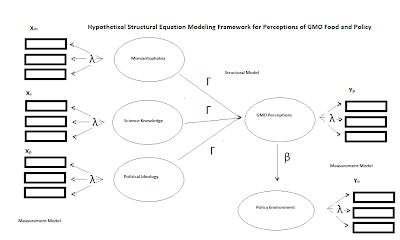
I'm not a PhD Economist or Psychometrician but I would think an approach similar to the structural equation modeling framework I discussed before (depicted below) might get closer to specifying and measuring all of the causal paths and connections between latent constructs around risk perception and the policy environment for GMOs or climate change. Of course that would also require a solid data set and valid survey instruments. Jayson's work seems to be leading the way. These are just my initial thoughts prior to even reading the Jayson and McFadden article or the JARE article mentioned above and honestly I have not reviewed much of the actual literature or survey analysis related to risk and perceptions or policy preferences since graduate school. Maybe a lot of this has been done already.
(click to enlarge)
.png)

“One distinction, which I think is missing, is the greater willingness of those on the left to regulate on economic issues, such as GMOs, than those on the right. Stated differently, there are questions of science: what are the risks of climate change or eating GMOs. And then there are more normative questions: given said risk, what should we do about it? Even if the left and the right agreed on the level of risk, I don’t think we should expect agreement on political action.”
If I understand this correctly, I think this implies that if both those on the left and right agreed that there was some 'day after tomorrow' scenario (in terms of climate change) that warranted some type of government intervention, and they agreed that the science says there is a 3% chance of it happening without the intervention, then those on the right might object to the intervention for that given level of risk while a more left leaning person would support it. A right leaning person might suggest more market based alternatives or taking the gamble. But perhaps if the risk were higher, they might support doing more. In other words there might be different thresholds for the level of risk required to support a given policy interventions across the political spectrum.
Of course, the scientific consensus on climate change may not really even be strong enough to know for sure, i.e. the science isn't settled on exactly what scenarios are likely to play out and the probabilities that they will occur. There's a lot of science to support a wide range of probabilities and scenarios based on a number of assumptions. (see here, here, here, and here). So really, I think even the science, risk, and potential outcomes or scenarios are largely based on perceptions and these might actually differ significantly across the political spectrum. Maybe its really about perceived risk.
Just thinking about this a little more what if we specified a model of preferences toward government intervention like that below (this is more an illustration than a serious attempt to look at this empirically):
Pr(SUPPORT POLICY) = B0 + B1 PERCEIVED RISK + B2 KNOWLEDGE
So if we estimated simple linear probability models as specified above for democrats and republicans (as short hand for political preferences) according to the story line above B1 would be higher for democrats than republicans. (I'm ignoring the use of interaction terms on purpose for simplicity) I wonder if this would also be true for B2, for a given level of knowledge, would B2 be higher for democrats/liberals? I also wonder if PERCIEVED RISK is really a function of KNOWLEDGE? Maybe a different specification would look something like:
Pr(SUPPORT POLICY) = B0 + B1 PERCEIVED RISK(KNOWLEDGE)
where PERCEIVED RISK = f(KNOWLEDGE)
So in this case perhaps B1 would still be higher for those with more left leaning politics. Still I wonder, besides this effect, what if its the case that the level or mean of PERCEIVED RISK is in general higher for those on the left? So you have this effect of a greater inclination for a preference for government intervention given a level of PERCEIVED RISK (via B1) but also a population of left leaning voters with a PERCEIVED RISK levels that are on average some magnitude higher. Both of these effects would likely increase the propensity of supporting government intervention.
Consider also....if PERCEIVED RISK = f(KNOWLEDGE), is the level of KNOWLEDGE about GMOs or climate change the same for those on the left and right and is this really what is partly determining different levels of PERCEIVED RISK? I'm not sure....how often do we hear arguments from the left that drastic actions or mitigating policies to combat climate change are necessary because of the scientific consensus on climate change when in fact the consensus as it is is pretty weak. Too weak to offer much guidance on actions, or very precise estimates of actual risks. (again see here, here, here, and here). And even some of the world's leading experts in risk modeling tend to have some ideas about GMO risks that can be seriously questioned (see here). There was a really good book a few years back discussing voter preferences and systemic bias regarding economic policy that addressed similar issues (see The Myth of the Rational Voter).
If preferences toward policy can be modeled in this way, an interesting and maybe promising feature is that perhaps the level of knowledge feeding into PERCEIVED risk can be altered. We often hear that science and evidence rarely will change minds when it comes to biotechnology or climate change, however, in a paper recently published by the Journal of the Federation for American Societies for Experimental Biology (FASEB) Jayson and Brandon McFadden observed the following:
1) consumers, as a group, are unknowledgeable about GMOs, genetics, and plant breeding and, perhaps more interestingly
2) simply asking these objective knowledge questions served to lower subjective, self-assessed knowledge of GMOs (i.e., people realize they didn't know as much as they thought they did) and increase the belief that it is safe to eat GM food.
I'm not a PhD Economist or Psychometrician but I would think an approach similar to the structural equation modeling framework I discussed before (depicted below) might get closer to specifying and measuring all of the causal paths and connections between latent constructs around risk perception and the policy environment for GMOs or climate change. Of course that would also require a solid data set and valid survey instruments. Jayson's work seems to be leading the way. These are just my initial thoughts prior to even reading the Jayson and McFadden article or the JARE article mentioned above and honestly I have not reviewed much of the actual literature or survey analysis related to risk and perceptions or policy preferences since graduate school. Maybe a lot of this has been done already.
(click to enlarge)
.png)
Sunday, November 01, 2015
The Cult of Statistical Significance...or...no bacon is not really as bad or worse than cigarettes!
In their very well known article "The Cult of Statistical Significance", Ziliak and McCloskey write:
"William Sealy Gosset (1876-1962) aka “Student,” working as Head Experimental Brewer at Guinness’s Brewery, took an economic approach to the logic of uncertainty. Fisher erased the consciously economic element, Gosset's "real error." We want to bring it back….Statistical significance should be a tiny part of an inquiry concerned with the size and importance of relationships."
For those unfamiliar with the history of statistics, Gosset was the one that came up with the well known t-test so many of us run across in any basic statistics class. A lot of issues are addressed in this paper, but to me one related theme is the importance of 'practical' or what I might call 'actionable' statistics. And context matters. Are the results relevant for practical consideration? Is the context realistic? Are there proper controls? What about identification? For instance, not long ago I wrote about a study that attempted to correlate distance from a farm field and exposure to pesticides and autism that has been criticized for a number of these things, even though the results were found to be statistically significant. As well as this one attempting to claim that proteins from Bt (read "gmo") corn were found in the blood of pregnant women. And...not to forget, the famous Serelini study that claimed to connect roundup herbicide to cancer in rats, that was so bad that it was retracted. Context, and economics (how people behave in the context of real world decision making scenarios) really matter. Take for instance, California's potential consideration to put roundup on a list of known carcinogens that might actually cause environmental harms in a number of ways magnitudes worse than roundup itself ever could.
So what does this all have to do with bacon? Well recently you might have heard a headline like this: “Processed meats rank alongside smoking as cancer causes – WHO.”
This is a prime example of the importance of putting science and statistical significance, effect sizes, context (like baseline risks in the case of WHO quote above) and practical significance into perspective. Millions of people have heard this headline, taken the science at face value, and either acted on it or given it way more credence and lip service than it deserves. At a minimum every time for the rest of their life they have a piece of bacon they might think, wow, this could be almost as bad or worse than smoking.
Economist Jayson Lusk has a really nice post related to this with several quotes from a number of places, and I'm going to borrow a few here. From an article he links to in the Atlantic:
"the practice of lumping risk factors into categories without accompanying description—or, preferably, visualization—of their respective risks practically invites people to view them as like-for-like. And that inevitably led to misleading headlines like this one in the Guardian: “Processed meats rank alongside smoking as cancer causes – WHO.”
“One thing rarely communicated in these sorts of reports is the baseline level of risk. Let's use Johnson's example and suppose that eating three pieces of bacon everyday causes cancer risk to increases 18%. From what baseline? To illustrate, let's say the baseline risk of dying from colon cancer (which processed meat is supposed to cause) is 2% so that 2 out of every 100 die from colon cancer over their lifetime (this reference suggests that's roughly the baseline lifetime risk for everyone including those who eat bacon). An 18% increase means your risk is now 2.36% for a 0.36 percentage point increase in risk. I suspect a lot of people that would accept a less-than-half-a-percentage point increase in risk for the pleasure of eating bacon….studies that say that eating X causes a Y% increase in cancer are unhelpful unless I know something about my underlying, baseline probably of cancer is without eating X.”
The real cult of statistical significance (and in effect all of the so called science that follows from it) is a cult like believing and following by multitudes that hear about this study or that, overly dramatized by media headlines, (even if it is a solid study, potentially taken out of context and misinterpreted to fit a given agenda or emotive response), and then synthesized into corporate marketing campaigns and unfortunately public policies. Think gmo labeling, gluten free, antibiotic free, climate change policy, ad naseam.
"William Sealy Gosset (1876-1962) aka “Student,” working as Head Experimental Brewer at Guinness’s Brewery, took an economic approach to the logic of uncertainty. Fisher erased the consciously economic element, Gosset's "real error." We want to bring it back….Statistical significance should be a tiny part of an inquiry concerned with the size and importance of relationships."
For those unfamiliar with the history of statistics, Gosset was the one that came up with the well known t-test so many of us run across in any basic statistics class. A lot of issues are addressed in this paper, but to me one related theme is the importance of 'practical' or what I might call 'actionable' statistics. And context matters. Are the results relevant for practical consideration? Is the context realistic? Are there proper controls? What about identification? For instance, not long ago I wrote about a study that attempted to correlate distance from a farm field and exposure to pesticides and autism that has been criticized for a number of these things, even though the results were found to be statistically significant. As well as this one attempting to claim that proteins from Bt (read "gmo") corn were found in the blood of pregnant women. And...not to forget, the famous Serelini study that claimed to connect roundup herbicide to cancer in rats, that was so bad that it was retracted. Context, and economics (how people behave in the context of real world decision making scenarios) really matter. Take for instance, California's potential consideration to put roundup on a list of known carcinogens that might actually cause environmental harms in a number of ways magnitudes worse than roundup itself ever could.
So what does this all have to do with bacon? Well recently you might have heard a headline like this: “Processed meats rank alongside smoking as cancer causes – WHO.”
This is a prime example of the importance of putting science and statistical significance, effect sizes, context (like baseline risks in the case of WHO quote above) and practical significance into perspective. Millions of people have heard this headline, taken the science at face value, and either acted on it or given it way more credence and lip service than it deserves. At a minimum every time for the rest of their life they have a piece of bacon they might think, wow, this could be almost as bad or worse than smoking.
Economist Jayson Lusk has a really nice post related to this with several quotes from a number of places, and I'm going to borrow a few here. From an article he links to in the Atlantic:
"the practice of lumping risk factors into categories without accompanying description—or, preferably, visualization—of their respective risks practically invites people to view them as like-for-like. And that inevitably led to misleading headlines like this one in the Guardian: “Processed meats rank alongside smoking as cancer causes – WHO.”
“One thing rarely communicated in these sorts of reports is the baseline level of risk. Let's use Johnson's example and suppose that eating three pieces of bacon everyday causes cancer risk to increases 18%. From what baseline? To illustrate, let's say the baseline risk of dying from colon cancer (which processed meat is supposed to cause) is 2% so that 2 out of every 100 die from colon cancer over their lifetime (this reference suggests that's roughly the baseline lifetime risk for everyone including those who eat bacon). An 18% increase means your risk is now 2.36% for a 0.36 percentage point increase in risk. I suspect a lot of people that would accept a less-than-half-a-percentage point increase in risk for the pleasure of eating bacon….studies that say that eating X causes a Y% increase in cancer are unhelpful unless I know something about my underlying, baseline probably of cancer is without eating X.”
The real cult of statistical significance (and in effect all of the so called science that follows from it) is a cult like believing and following by multitudes that hear about this study or that, overly dramatized by media headlines, (even if it is a solid study, potentially taken out of context and misinterpreted to fit a given agenda or emotive response), and then synthesized into corporate marketing campaigns and unfortunately public policies. Think gmo labeling, gluten free, antibiotic free, climate change policy, ad naseam.
Thursday, October 29, 2015
Applied Microeconomics: The Normative Representative Consumer and Welfare Analysis
In a previous post, I pondered some questions related to using market demand functions to make welfare statements, following broadly Microeconomic Theory by Andreu Mas-Colell, Michael D. Whinston, and Jerry R. Green (MWG).
Making
welfare statements about aggregate demand revolves around a few key
concepts including a positive representative consumer, a wealth
distribution rule, and a
social welfare function. At a high level, these concepts seem to represent the technical assumptions and characteristics that need to hold in order to make most of the basic analysis of an intermediate microeconomics course mathematically sound or tractable for applied work. Here is a shot at some high level explanations:
positive
representative consumer- at a high level, a hypothetical consumer
who's UMP facing society's budget constraint generates a market or
economy's aggregate
demand function
wealth distribution rule - for every level of aggregate wealth, assigns individual wealth.
This
rule or function is what allows us to write aggregate demand as a
function of prices and wealth in order to move forward with the rest of
our discussion about
welfare analysis.
Examples
given in MWG include wealth distribution rules that are a function of
shareholdings of stocks and commodities which make wealth a function of
the market's
price vector
social
welfare function (SWF) - this assigns utility to the vector of utilities for
all 'I' consumers in an economy or market. W(u1,.....,uI) or can be
written in terms
of indirect utilities W(v1,....vI).
Maximizing Social Welfare and Defining the Normative Representative Consumer
The
wealth distribution rule is assumed to maximize society's social
welfare function subject to a given level of aggregate wealth. The
optimal solution indicates
a particular indirect utility function v(p,w)
Normative
Representative Consumer- a positive representative consumer is a
normative representative consumer relative to social welfare function
W(.) if for every
(p,w) the distribution of wealth maximizes W(.). v(p,w) in the optimum
is the indirect utility function for the normal representative consumer.
For
v(p,w) to exist, we are assuming a SWF, and assuming it is maximized by an
optimal distribution of wealth according to some specified wealth
distribution rule.
An example from MWG: When v(p,w) is of the Gormon form, and the SWF is utilitarian, then an aggregate demand function can always be viewed as being generated by a normative representative consumer.
Tuesday, October 27, 2015
Applied Microeconomics: The Strong Axiom of Revealed Preference,Aggregation, and Rational Preferences
Professionally most of my focus has been empirical and to a great extent, has been agnostic when it comes to micro theory. Take data mining and machine learning, social network analysis, text mining or issues related to big data for instance. Or many of the other issues I have taken up at EconometricSense. A lot of what I have worked on has been more about data, algorithms, and experimental design than the nuts and bolts of microeconomic theory.
However, there are some theoretical issues in microeconomics that I either have forgotten, or never really understood that well.
Particularly these issues have to do with the strong axiom of revealed preference, the market aggregated demand function, and welfare analysis as discussed in one of my graduate texts (Microeconomic Theory by Andreu Mas-Colell, Michael D. Whinston, and Jerry R. Green). From that text (MWG) I basically get the following:
What happens when we aggregate individual demand to get a market demand function? It seems to me that the data of interest in most applied work is going to be related to an aggregate market demand curve. Based on Green et al:
Is this a case where one should just take the example of Milton Freidman's pool players who behave as if they know physics? Maybe all of the assumptions (like the SA) fail to hold for a market demand function, but we still feel confident making directional or qualitative welfare statements about price changes because everything else about the model predicts so well?
Any thoughts from readers?
I found it interesting, that the issues in the bulleted statements related to the MWG text were never addressed that I can tell in any of my undergraduate principles or intermediate micro texts, nor even in Nicholson's more advanced graduate text. It just seems like these texts jump from individual demand to market demand as a horizontal summation of individual's demand curves and go straight to welfare analysis and discussions about consumer surplus without discussing these issues related to the SA.
Note: I definitely spent some time with the issue of consumer surplus calculations based on compensated vs uncompensated demand curves. I don't think that is the issue here at all.
****updated modified on October 29, 2015
However, there are some theoretical issues in microeconomics that I either have forgotten, or never really understood that well.
Particularly these issues have to do with the strong axiom of revealed preference, the market aggregated demand function, and welfare analysis as discussed in one of my graduate texts (Microeconomic Theory by Andreu Mas-Colell, Michael D. Whinston, and Jerry R. Green). From that text (MWG) I basically get the following:
- The strong axiom (SA) of revealed preference is equivalent to the symmetry and negative semi-definiteness of the slutsky substitution matrix
- Violations of the SA mean cycling of choices or violations of transitivity
- If observed demand follows the SA, then preferences that rationalize demand can always be recovered
- It is impossible to find preferences that rationalize a demand function when the slutsky matrix is not symmetric
What happens when we aggregate individual demand to get a market demand function? It seems to me that the data of interest in most applied work is going to be related to an aggregate market demand curve. Based on Green et al:
- the chances of the SA "being satisfied by a real economy are essentially zero"
- If we allow individuals in an economy to have different preference relations/utility functions, when we aggregate to get a market demand function, the negative semi-definiteness of the slutsky matrix (equivalent to the weak axiom of revealed preference) might hold, but "symmetry will almost certainly not."
- While positive effects of an equilibrium might hold, without symmetry the SA does not and we therefore cannot make statements about consumer welfare based on the area beneath an observed empirical market demand function
- What does that imply with regard to empirical work? It seems to not matter for positive effects (for instance a conclusion that a wage set above equilibrium causes a surplus of labor).
- But, how much does it matter that I can't use an empirical demand function to calculate changes in consumer surplus for a change in prices? Maybe it only matters if I am interested in calculating some amount?
- For any individual, if the SA might holds (which is possible), we certainly know a price increase would reduce consumer surplus, put them on a lower indifference curve and make them worse off. Regardless of the conclusions above, wouldn't that hold for all consumers represented by the aggregate market demand curve? Can't we make a normative statement (in terms of a qualitative directional sense even if we can't calculate total surplus) about all consumers even if the SA fails in the aggregate but holds for each individual?
Is this a case where one should just take the example of Milton Freidman's pool players who behave as if they know physics? Maybe all of the assumptions (like the SA) fail to hold for a market demand function, but we still feel confident making directional or qualitative welfare statements about price changes because everything else about the model predicts so well?
Any thoughts from readers?
I found it interesting, that the issues in the bulleted statements related to the MWG text were never addressed that I can tell in any of my undergraduate principles or intermediate micro texts, nor even in Nicholson's more advanced graduate text. It just seems like these texts jump from individual demand to market demand as a horizontal summation of individual's demand curves and go straight to welfare analysis and discussions about consumer surplus without discussing these issues related to the SA.
Note: I definitely spent some time with the issue of consumer surplus calculations based on compensated vs uncompensated demand curves. I don't think that is the issue here at all.
****updated modified on October 29, 2015
Wednesday, September 30, 2015
Big Data, Ag Finance, and Risk Management
I recently was reading an article on AgWeb, How the feds interest rate decision affects farmers; and the following remarks stood out to me:
“You need to plan for higher rates. Yellen said in her remarks that the expectation is that the federal funds rate will rise to 1.5% by late 2016, 2.5% in late 2017, and 3.5% in 2018, so increases are coming. You can manage those hits by improving your efficiency and productivity in your fields and in your financials, which will allow you so to provide detailed cost projections and yield estimates to your banker. “Those farmers who are dialing those numbers in will be able to negotiate a better interest rate, simply by virtue of all that information,” Barron says.”
So to me this brings up some interesting questions. How interested are lenders in knowing about farmers data management and how they are leveraging their data generated across their enterprise? Does your farm need an IoT strategy? Or will these things work their way out in the financials lenders already look at regardless?
Regardless of what lenders are after, it would make sense to me that producers would want to make the most of their data to manage productivity and efficiency in both good and bad times. Firms like FarmLink come to mind.
From a research perspective, I would have some additional questions:
Big Ag Meets Big Data (Part 1 & Part 2)
Big Data- Causality and Local Expertise are Key in Agronomic Applications
Big Ag and Big Data-Marc Bellemare
Other Big Data and Agricultural related Application Posts at
Causal Inference and Experimental Design Roundup
“You need to plan for higher rates. Yellen said in her remarks that the expectation is that the federal funds rate will rise to 1.5% by late 2016, 2.5% in late 2017, and 3.5% in 2018, so increases are coming. You can manage those hits by improving your efficiency and productivity in your fields and in your financials, which will allow you so to provide detailed cost projections and yield estimates to your banker. “Those farmers who are dialing those numbers in will be able to negotiate a better interest rate, simply by virtue of all that information,” Barron says.”
So to me this brings up some interesting questions. How interested are lenders in knowing about farmers data management and how they are leveraging their data generated across their enterprise? Does your farm need an IoT strategy? Or will these things work their way out in the financials lenders already look at regardless?
Regardless of what lenders are after, it would make sense to me that producers would want to make the most of their data to manage productivity and efficiency in both good and bad times. Firms like FarmLink come to mind.
From a research perspective, I would have some additional questions:
- Is there a causal relationship between producers that leverage IoT and Big Data analytics applications and farm output/performance/productivity
- How do we quantify the outcome-is it some measure of efficiency or some financial ratio?
- If we find improvements in this measure-is it simply a matter of selection? Are great producers likely to be productive anyway, with or without the technology?
- Among the best producers, is there still a marginal impact (i.e. treatment effect) for those that adopt a technology/analytics based strategy?
- Can we segment producers based on the kinds of data collected by IoT devices on equipment, aps, financial records, GPS etc.? (maybe this is not that much different than the TrueHarvest benchmarking done at FarmLink) and are there differentials in outcomes, farming practices, product use patterns etc. by segment
Big Ag Meets Big Data (Part 1 & Part 2)
Big Data- Causality and Local Expertise are Key in Agronomic Applications
Big Ag and Big Data-Marc Bellemare
Other Big Data and Agricultural related Application Posts at
Causal Inference and Experimental Design Roundup
Friday, September 25, 2015
EconTalk: Matt Ridley, Martin Weitzman, Climate Change and Fat Tails
In a recent EconTalk podcast with Russ Roberts, Matt Ridley comments on a previous discussion with Martin Weitzman regarding the tail risk associated with climate change:
"the fat tail on the distribution, the relatively significant even if small possibility of a really big warming has got a heck of a lot thinner in recent years. This is partly because there was a howling mistake in the 2007 IPCC Report, the AR4 Report (Fourth Assessment Report: Climate Change, 2007), where a graph was actually distorted. And a brilliant scientist named Nick Lewis pointed this out later. It's one of the great, shocking scandals of this, that a graph--and I'm literally talking about the shape of the tail of the graph--was distorted to make a fatter tail than is necessary. When you correct that, the number gets smaller. When you feed in all these 14 papers that I've been talking about, all the latest observational data, 42 scientists involved in publishing this stuff, most of the mainstream scientists--I'm not talking about skeptics here--when you feed all that in and you get the average probability density functions for climate sensitivity, they turn out to have much thinner tails than was portrayed in the 2007. And that Martin Weitzman is basing his argument on. So the 10% chance of 6 degrees of warming in 100 years becomes much less than 1% if you look at these charts now."
Very interesting, because I thought Weitzman's discussion of tail risk was compelling. Unlike Nassem Taleb's characterization of tail risk and GMOs. I think a key to policy analysis must revolve around getting the distribution correct, particularly the tails of the distribution, then getting the discount rate correct as well. Will there ever truly be a consensus in relation to climate change policy?
"the fat tail on the distribution, the relatively significant even if small possibility of a really big warming has got a heck of a lot thinner in recent years. This is partly because there was a howling mistake in the 2007 IPCC Report, the AR4 Report (Fourth Assessment Report: Climate Change, 2007), where a graph was actually distorted. And a brilliant scientist named Nick Lewis pointed this out later. It's one of the great, shocking scandals of this, that a graph--and I'm literally talking about the shape of the tail of the graph--was distorted to make a fatter tail than is necessary. When you correct that, the number gets smaller. When you feed in all these 14 papers that I've been talking about, all the latest observational data, 42 scientists involved in publishing this stuff, most of the mainstream scientists--I'm not talking about skeptics here--when you feed all that in and you get the average probability density functions for climate sensitivity, they turn out to have much thinner tails than was portrayed in the 2007. And that Martin Weitzman is basing his argument on. So the 10% chance of 6 degrees of warming in 100 years becomes much less than 1% if you look at these charts now."
Very interesting, because I thought Weitzman's discussion of tail risk was compelling. Unlike Nassem Taleb's characterization of tail risk and GMOs. I think a key to policy analysis must revolve around getting the distribution correct, particularly the tails of the distribution, then getting the discount rate correct as well. Will there ever truly be a consensus in relation to climate change policy?
EconTalk: Matt Ridly on Climate Change Consensus
In a fairly recent EconTalk podcast with Russ Roberts, Matt Ridley discusses the consensus about climate change:
"if it's true that 97% of scientists are all of a particular view about climate, then let's go and ask what that view is. And if you go and look at the origin of that figure, it was that a certain poll--of 79 scientists, by the way, an extraordinarily small sample--said that, 97% of them agreed that human beings had influenced climate and that carbon dioxide was greenhouse gas....it's not referring to a consensus about dangerous climate change. It's referring to a consensus about humans' ability to affect the climate."
This is similar to what I wrote before back in 2008 after actually reading the IPCC 4th Assessment report. And more recently I have commented on how difficult it may be to solve the knowledge problem and actually attempt to price carbon (for which there is no consensus), and given this consensus view, from a policy perspective, the science just might not support doing anything drastic to try to stop climate change (i.e. carbon taxes, CAFE standards, other regulations).
So I continue to think that you don't necessarily have to be a climate change skeptic or 'denier' to be a denier on climate policy (or at least push back a little)
"if it's true that 97% of scientists are all of a particular view about climate, then let's go and ask what that view is. And if you go and look at the origin of that figure, it was that a certain poll--of 79 scientists, by the way, an extraordinarily small sample--said that, 97% of them agreed that human beings had influenced climate and that carbon dioxide was greenhouse gas....it's not referring to a consensus about dangerous climate change. It's referring to a consensus about humans' ability to affect the climate."
This is similar to what I wrote before back in 2008 after actually reading the IPCC 4th Assessment report. And more recently I have commented on how difficult it may be to solve the knowledge problem and actually attempt to price carbon (for which there is no consensus), and given this consensus view, from a policy perspective, the science just might not support doing anything drastic to try to stop climate change (i.e. carbon taxes, CAFE standards, other regulations).
So I continue to think that you don't necessarily have to be a climate change skeptic or 'denier' to be a denier on climate policy (or at least push back a little)
Friday, September 11, 2015
Does California's EPA really have an 'intent' to put Glyphosate on its list of 'known' carcinogens?
There have been some recent headlines lately about California's EPA expressing an 'intent' to put glyphosate on its list of 'known' carcinogens.
Here is one example: http://www.ewg.org/agmag/2015/09/california-moves-protect-citizens-monsanto-s-gmo-weed-killer
Yes, a subgroup of the WHO did suggest not long ago that glyphosate was a 'probable' carcinogen, but I wonder if hairdressers, or third or swing shift workers are going to get a warning printed on their payroll slip telling them that along with roundup herbicide, their profession is known to the state of California to cause cancer?
Here's more:
"In recent years use of glyphosate has exploded from 10 million pounds in 1993 to 280 million pounds in 2012. More than 90 percent of soybeans grown in the United States are genetically modified to withstand Roundup, which ends up in the beans themselves. More glyphosate is found in genetically modified soybeans than non-GMO varieties....The widespread use of this toxic herbicide in GMO food production is one reason more than 90 percent of Americans want foods containing genetically engineered ingredients to be labeled. Americans should have the same right as consumers in 64 other countries around the world when it comes to knowing what’s in their food."
'Widespread use of this toxic herbicide?' That is a very interesting statement. Sure, toxic might make sense in comparison to a pure source of crystal clear mountain spring water. But we are not going to sustainably feed the world on rainbows, fresh cut flowers, and crystal clear water.
Of all of the chemicals used in modern agriculture, roundup is one that should be most applauded by those with environmental and health concerns, not stigmatized. When you consider its relative toxicity compared to a number of chemistries it has replaced, and its prominent and complementary role in GMO crops and the associated drastic reductions in greenhouse gas emissions, increased practice of no-till, and reduced runoff and groundwater pollution (i.e. nitrates in groundwater and algal blooms among other things) you might consider the roundup + roundup ready technology as one of the 'greenest' technologies ever put on the market.
Of course, maybe there is some inherent rent seeking going on behind the scenes, special interests interested in labeling and others might see the success of a sustainable technology like this as huge barrier to their political agenda, or business strategy (think Chipotle). The more this can be stigmatized in the media and through political means (like labeling or California's prop 65 list) the better they set strategically in advancing their agenda. Of course, it also (at least short term) doesn't hurt the other manufacturers of more toxic chemicals and might help get back some market share! I'm sure those happy about the California news would never consider it, but I think a world without roundup (or glyphosate in general) would be a world with more toxic chemical intensive agriculture.
Oh yeah, and Americans deserve the same right as citizens in 64 other countries and the world for that matter of having a food and regulatory system based on sound science and rigorous economic policy analysis.
See also:
Modern Sustainable Agriculture
Public Choice Theory for Agvocates
Here is one example: http://www.ewg.org/agmag/2015/09/california-moves-protect-citizens-monsanto-s-gmo-weed-killer
Yes, a subgroup of the WHO did suggest not long ago that glyphosate was a 'probable' carcinogen, but I wonder if hairdressers, or third or swing shift workers are going to get a warning printed on their payroll slip telling them that along with roundup herbicide, their profession is known to the state of California to cause cancer?
Here's more:
"In recent years use of glyphosate has exploded from 10 million pounds in 1993 to 280 million pounds in 2012. More than 90 percent of soybeans grown in the United States are genetically modified to withstand Roundup, which ends up in the beans themselves. More glyphosate is found in genetically modified soybeans than non-GMO varieties....The widespread use of this toxic herbicide in GMO food production is one reason more than 90 percent of Americans want foods containing genetically engineered ingredients to be labeled. Americans should have the same right as consumers in 64 other countries around the world when it comes to knowing what’s in their food."
'Widespread use of this toxic herbicide?' That is a very interesting statement. Sure, toxic might make sense in comparison to a pure source of crystal clear mountain spring water. But we are not going to sustainably feed the world on rainbows, fresh cut flowers, and crystal clear water.
Of all of the chemicals used in modern agriculture, roundup is one that should be most applauded by those with environmental and health concerns, not stigmatized. When you consider its relative toxicity compared to a number of chemistries it has replaced, and its prominent and complementary role in GMO crops and the associated drastic reductions in greenhouse gas emissions, increased practice of no-till, and reduced runoff and groundwater pollution (i.e. nitrates in groundwater and algal blooms among other things) you might consider the roundup + roundup ready technology as one of the 'greenest' technologies ever put on the market.
Of course, maybe there is some inherent rent seeking going on behind the scenes, special interests interested in labeling and others might see the success of a sustainable technology like this as huge barrier to their political agenda, or business strategy (think Chipotle). The more this can be stigmatized in the media and through political means (like labeling or California's prop 65 list) the better they set strategically in advancing their agenda. Of course, it also (at least short term) doesn't hurt the other manufacturers of more toxic chemicals and might help get back some market share! I'm sure those happy about the California news would never consider it, but I think a world without roundup (or glyphosate in general) would be a world with more toxic chemical intensive agriculture.
Oh yeah, and Americans deserve the same right as citizens in 64 other countries and the world for that matter of having a food and regulatory system based on sound science and rigorous economic policy analysis.
See also:
Modern Sustainable Agriculture
Public Choice Theory for Agvocates
Monday, August 24, 2015
How Safe Is Your Ground Beef? Well, you tell me did you cook it properly?
I have recently came across an article in consumer reports:
http://www.consumerreports.org/cro/food/how-safe-is-your-ground-beef
This really gets interesting at the end when consumer reports actually recommends only grass fed and/or organic beef. (Never mind the negative environmental/sustainability issues that can also be associated with that) And their results on bacterial contamination are based on irrelevant comparisons between 'raw' ground beef. They did not test differences between properly handled and prepared ground beef, because the differences would be zero! It also makes me wonder, by making these kinds of recommendations are they possibly endangering some consumers by shaping perceptions in such a way that could promote 'risk homeostasis' - making consumers feel safer and likely take fewer precautions if they buy organic/grass fed premium brands? It seems to me the only responsible thing they should recommend is proper cooking and handling since that has the largest significant impact on safety regardless of how it's raised or marketed. I haven't actually unpacked the analysis or methodology on the 'raw' beef comparisons (as irrelevant as they may be) but am interested to see what kind of reactions come about from those that have!
http://www.consumerreports.org/cro/food/how-safe-is-your-ground-beef
This really gets interesting at the end when consumer reports actually recommends only grass fed and/or organic beef. (Never mind the negative environmental/sustainability issues that can also be associated with that) And their results on bacterial contamination are based on irrelevant comparisons between 'raw' ground beef. They did not test differences between properly handled and prepared ground beef, because the differences would be zero! It also makes me wonder, by making these kinds of recommendations are they possibly endangering some consumers by shaping perceptions in such a way that could promote 'risk homeostasis' - making consumers feel safer and likely take fewer precautions if they buy organic/grass fed premium brands? It seems to me the only responsible thing they should recommend is proper cooking and handling since that has the largest significant impact on safety regardless of how it's raised or marketed. I haven't actually unpacked the analysis or methodology on the 'raw' beef comparisons (as irrelevant as they may be) but am interested to see what kind of reactions come about from those that have!
Subscribe to:
Posts (Atom)